Umrah - fit
15 Days Aqsa Petra Umrah UMR-15D-AQ-A01
$5,450.00 SGD
🔥 UNBEATABLE UMRAH DEAL 15 DAYS Aqsa + Petra + Umrah FROM JUST $5450 SGD!!! - with 5* Hotels <100m to masjidil Haram, Fullboard Meals, Ziarah etc - Fully Guided, Luxury, STRESS-FREE! Perfect for busy professionals & school holidays! Focus ONLY on your ibadah—we handle EVERY detail.
Hotels Options
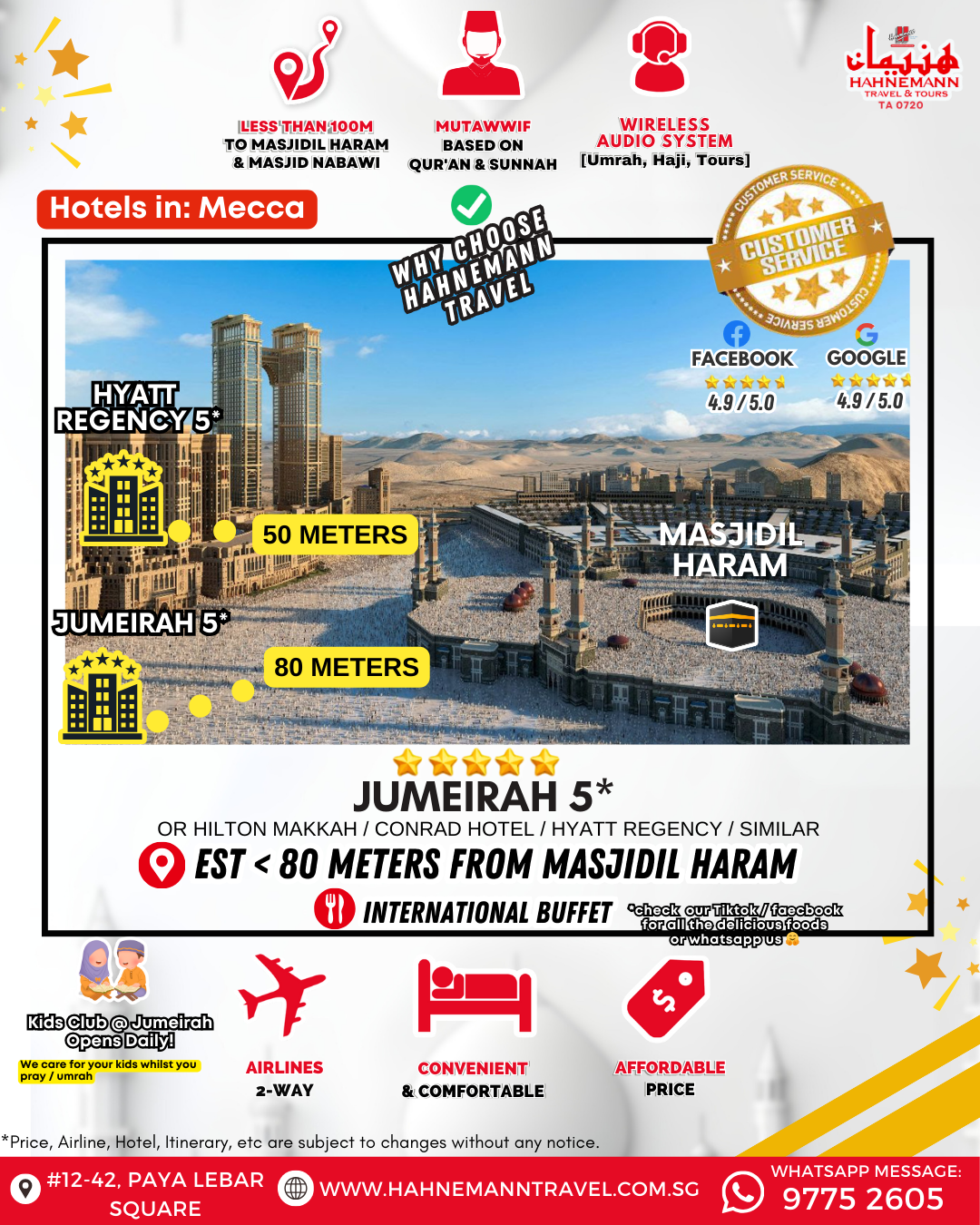
Jumeirah Jabal Omar Makkah
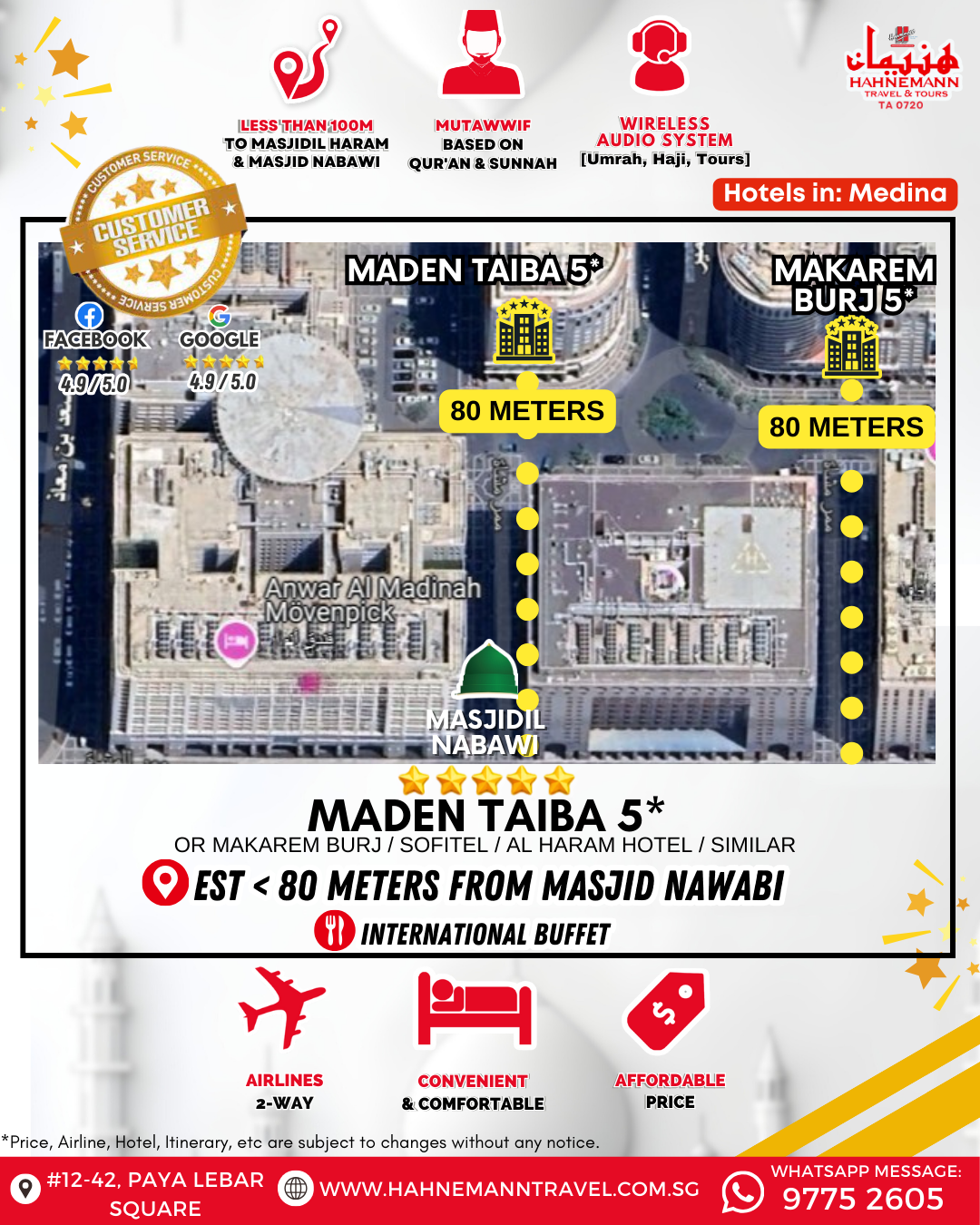
Maden Taiba Premium 5*Hotel | فندق مادن

Golden Tulip Hotel Amman, Jodan
+1 more hotel
Description
15 Days Aqsa Petra Umrah
Embark on a spiritually fulfilling journey with our premium 15 Days Aqsa Petra Umrah, carefully curated for pilgrims departing from Singapore. This all-inclusive pilgrimage itinerary is designed to give you complete peace of mind, handling every logistical detail from flight bookings and visa processing to expert-led spiritual guidance. Stay in luxury accommodation steps from the holy mosques and focus entirely on your ibadah while our experienced team handles the rest.
⭐⭐⭐⭐⭐ 4.9/5 STARS REVIEW
- Trusted by thousands of happy pilgrims & families!
🏨 5★ LUXURY HOTELS
- Just steps away from Masjidil Haram & Masjid Nabawi!
📅 EST. 1983
- 40+ years of trusted service & spiritual expertise!
👥 GROUP DISCOUNTS AVAILABLE
- More savings, more barakah, more spiritual unity!
✈️ TRUE ALL-IN PACKAGES
- Flights + Luxury Hotels + Halal Meals
🌙 100% MUSLIM-FRIENDLY
- Prayer times observed, halal food guaranteed, seamless spiritual tours!
🕋 TRAVEL IN BLESSED GROUPS
- More affordable, more motivating, more memorable—supporting one another in worship!
💰 CHEAPER THAN DIY!
- Our group deals mean MASSIVE SAVINGS—no hidden costs!
🛡️ Your Safety & Comfort is OUR PRIORITY
- We lead with care, ensuring your peace throughout the journey.
❤️ Family-Assured Travel
- Your loved ones at home can have total peace of mind—we treat every pilgrim like family!
Hajj / Umrah / Holiday Tours Made Easy
✨ Your Bridge to Jannah!
- Hahnemann Travel
---
### Plan Your Sacred Pilgrimage With Us
Planning a sacred trip requires absolute trust and reliability.
To ensure this is the perfect journey for your family, you can explore our complete itinerary breakdowns or compare this schedule against our alternative travel seasons by visiting our main [Hahnemann Travel Singapore Umrah Packages] catalog page.
Our dedicated team is always ready to assist you with group bookings or flight arrangements.
📱 WHATSAPP Message TO BOOK NOW:
Click here --> +65 9775 2605
Highlights
Jumeirah Jabal Omar Makkah
Plush rooms, some with views of the Grand Mosque, in a sleek hotel with a Mediterranean restaurant.
Maden Taiba Premium 5*Hotel | فندق مادن
Maden Taiba Premium 5* Hotel Madinah — est 80metres to Masjidil Nabawi VIP services, dining, and amenities at Maden Hotel. Pinnacle of luxury at Maden Hotel.
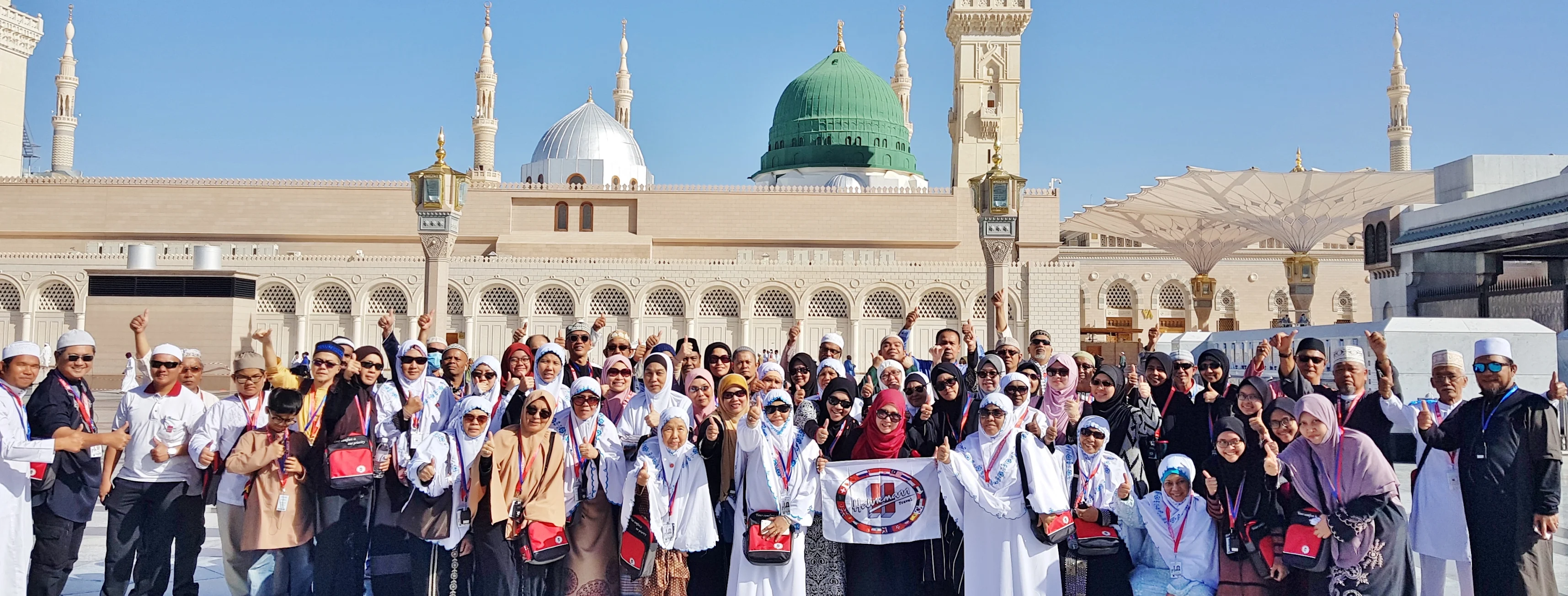
Masjid Nabawi
The Prophet's Muhammad ﷺ Mosque is the second mosque built by Rasulullah ﷺ after the Quba Mosque. It is the second holiest site in Islam, after the Masjid al-Haram in Mecca. Every prayer is Masjidil Nabawi is multiplied by 1000x !It also houses the Gardens of Paradise (Ar Rawdah / Raudah) on earth.Sahih Bukhari, Hadith No 1190:Allah's Messenger (ﷺ) said,"One prayer in my Mosque is better than one thousand prayers in any other mosque excepting Al-Masjid-AI-Haram."-https://sunnah.com/bukhari:1190...Sahih Bukhari, hadith No 1196:The Prophet (ﷺ) said,"Between my house and my pulpit there is a garden of the gardens of Paradise (Rawdah),and my pulpit is on my fountain tank (i.e. Al-Kauthar)."-https://sunnah.com/bukhari:1196...Sahih Bukhari, Hadith No 1189:The Prophet (ﷺ) said,"Do not set out on a journey except for three Mosques i.e. Al-Masjid-AI-Haram, the Mosque of Allah's Messenger (ﷺ) ,and the Mosque of Al-Aqsa, (Mosque of Jerusalem)."-https://sunnah.com/bukhari:1189...Sahih Bukhari, Hadith No 1871:Allah's Messenger (ﷺ) said,"I was ordered to migrate to a town which will swallow (conquer) other towns and is called Yathrib and that is Medina,and it turns out (bad) persons as a furnace removes the impurities of iron.-https://sunnah.com/bukhari:1871...Sahih Bukhari, Hadith No 1876:Allah's Messenger (ﷺ) said,"Verily, Belief returns and goes back to Medina as a snake returns and goes back to its hole (when in danger).-https://sunnah.com/bukhari:1876Madinah is the gathering-point of the Muslims in the beginning and at the end. An-Nawawi (may Allah have mercy on him) said:“Faith will retreat to Madinah” – what is meant is that this is how faith is in the beginning and at the end, because at the beginning of Islam, everyone whose faith was sincere and whose Islam was valid came to Madinah, either as a Muhajir (migrant) coming to settle there, or out of a longing to see the Messenger of Allah (ﷺ),andto learn from him and be near to him; then after that, at the time of the caliphs, people did the same, so they came to learn about the straight path from them and follow the example of the majority of the Companions (may Allah be pleased with them) living there;then after that, they came to learn from the scholars of Madinah who were a shining lamp of that era, and the Imams of guidance, to learn Islam and the Sunnah of the Messenger of Allah (ﷺ) that the Companions narrated to subsequent generations….Therefore everyone who was steadfast in faith and at ease with it would travel there. “(Sharh An-Nawawi ‘Ala Muslim, 2/177).Sahih Bukhari, Hadith No 1877:I heard the Prophet (ﷺ) saying,"None plots against the people of Medinabutthat he will be dissolved (destroyed) like the salt is dissolved in water."-https://sunnah.com/bukhari:1877...
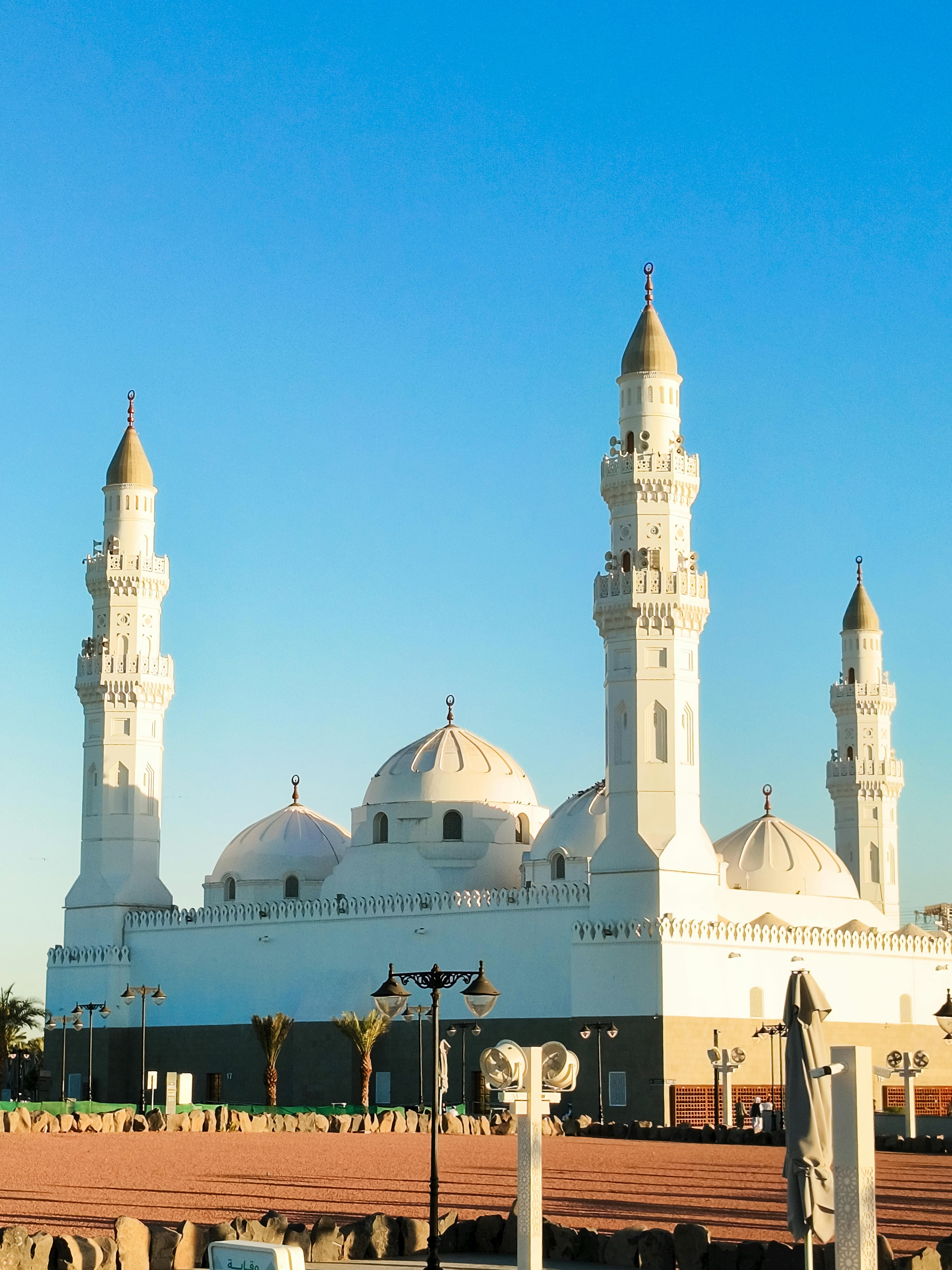
Masjid Quba
Spiritual pilgrimage site thought to date from the prophet Muhammad’s time in the 7th century CE.
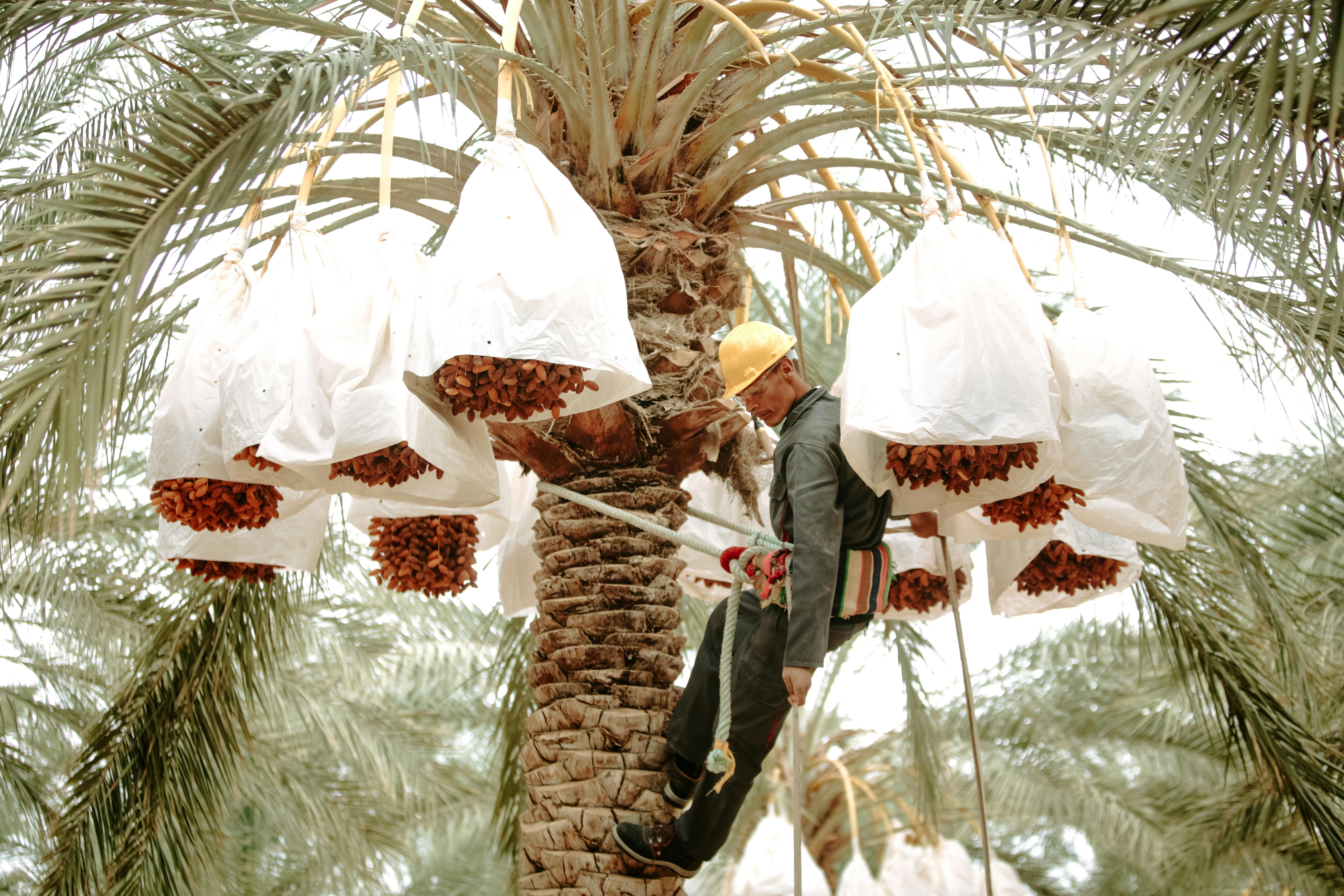
Salman Al Farsi Farm
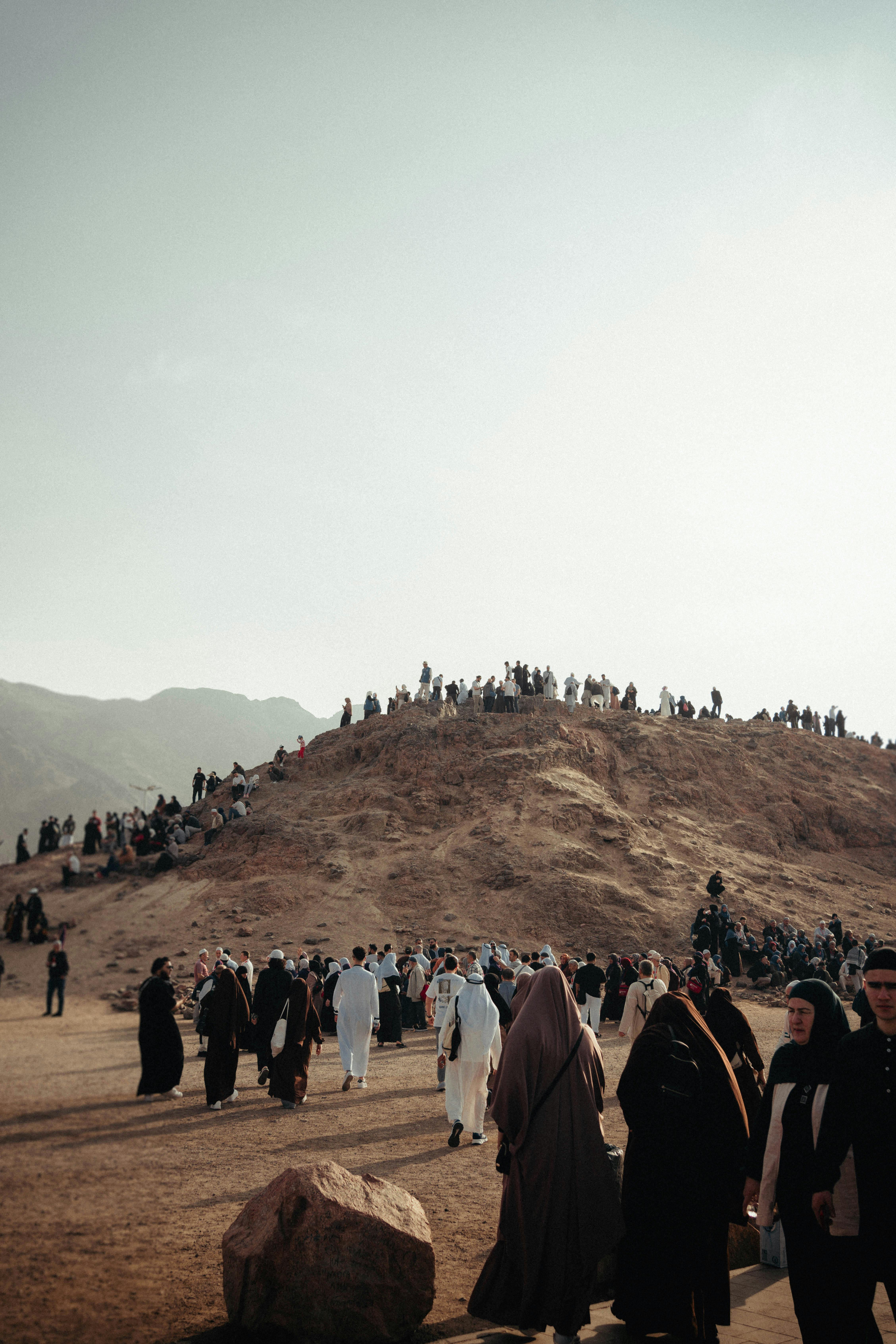
Uhud Mountain
Imposing, rocky ridge & site of the 624 CE Battle of Uhud between the Meccan army & early Muslims.
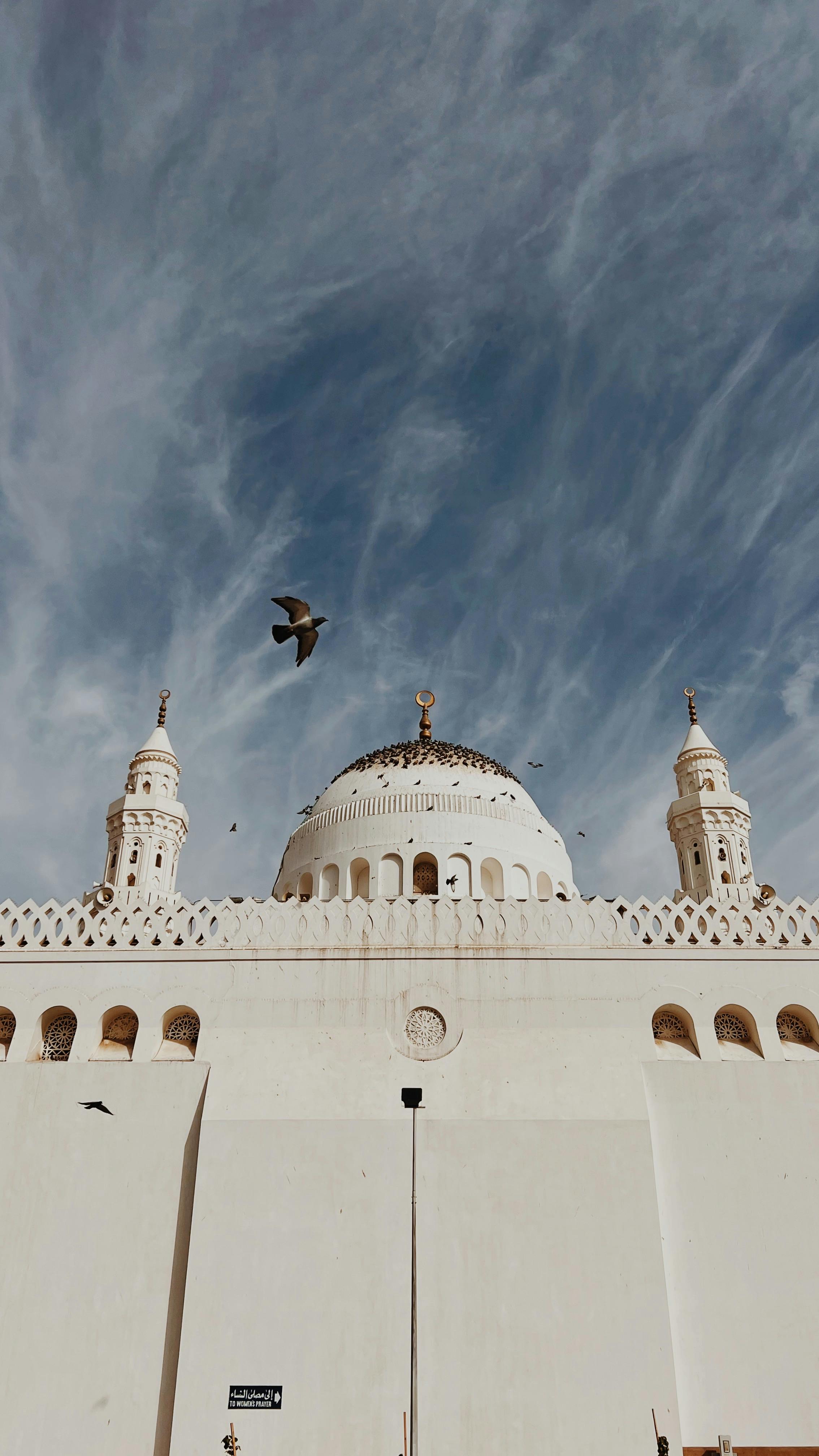
Masjid al-Qiblatayn
Twin-towered mosque where the prophet Muhammad redirected prayer from Jerusalem to Mecca in 624.
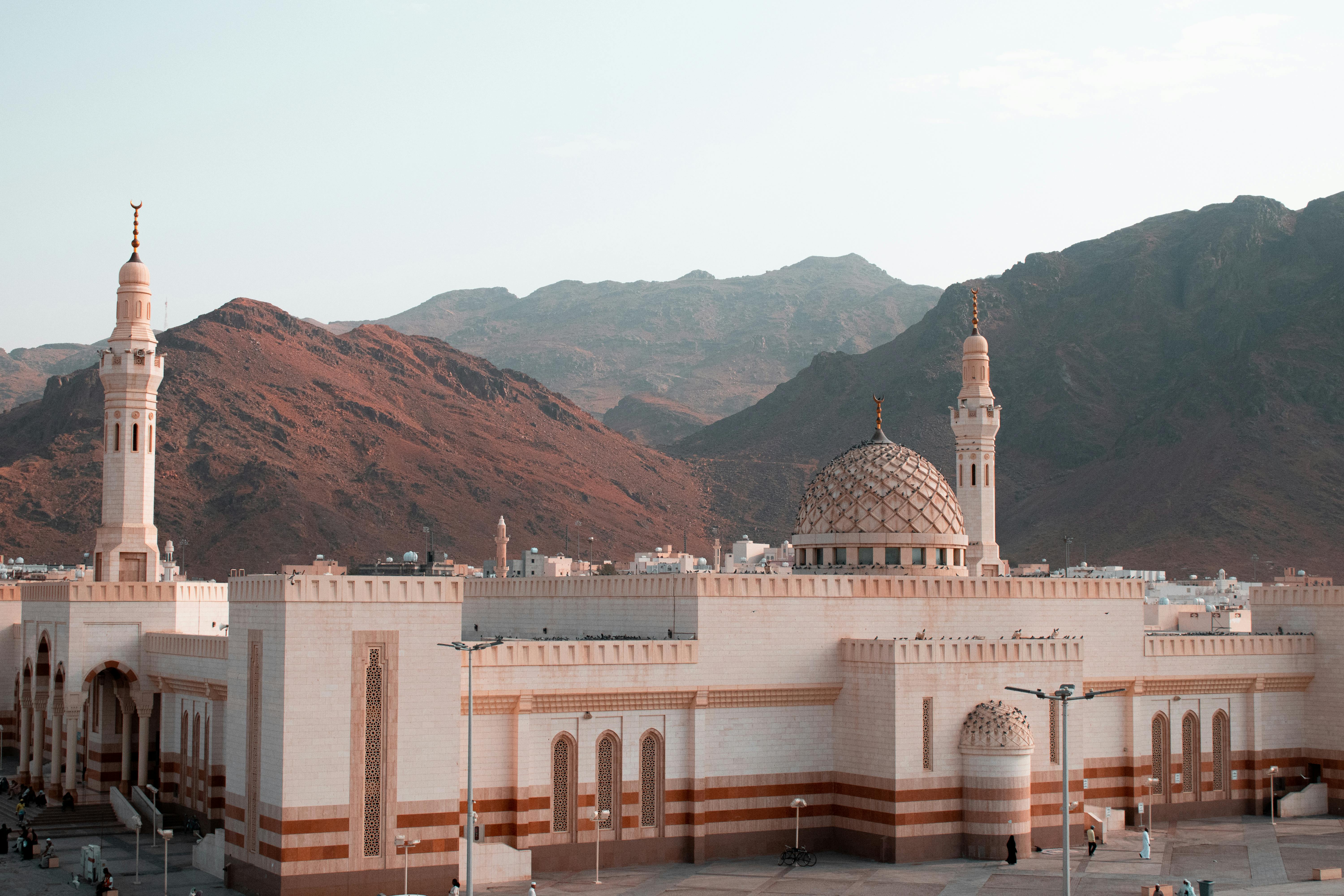
The Seven Mosques (Khandaq Mosque)
Striking place of worship with twin minarets backed by rugged cliffs, the site of an ancient battle.
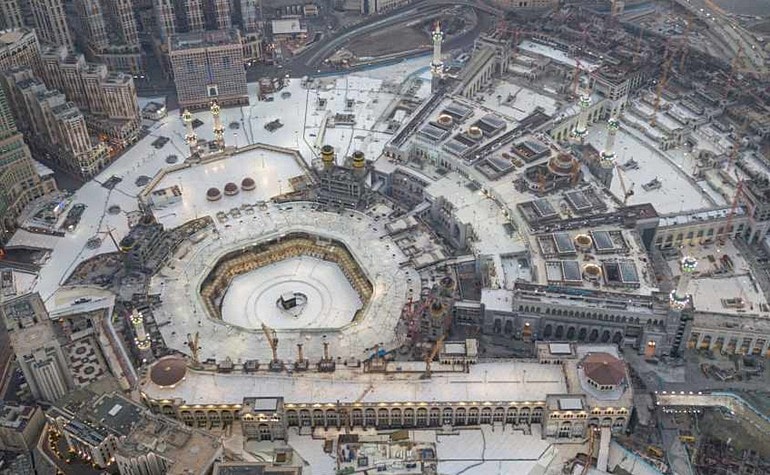
Masjid al-Haram
Known as the Great Mosque of Mecca, is a mosque in Mecca, Saudi Arabia, serving as the holiest and most important mosque in Islam.

Alamoudi Museum | متحف العمودي

Jamrah Al Aqabah Al-Kubra

Petra, Jordan
The city of Petra (Red Rose City), the capital of the Nabataeans. Iconic 2000-year-old city, including 45m-high Al Khazneh (The Treasury), carved into the red mountain rock. 120 km north of the Red Sea town of Aqaba, one of the seven wonders of the world! Surah Al Hijr, Chapter 15 verse 80 - 83 "The people of the Rock also rejected the messengers. We gave them Our revelations, but they turned away from them. They used to carve homes in the mountains, feeling secure. But the ˹mighty˺ blast overtook them in the morning."

Al-Aqsa Mosque
Masjid al-Aqsa is not only the Qibly mosque (with the silver/black dome). It is in fact the whole region including the Dome of the Rock where it is the 3rd holiest Mosque in Islam (any prayer done within this area is a multiplication of 250x and other hadith is 500x each prayer). Also known as Bayt al-Maqdis or Bayt al-Muqaddas (House of the Holiness). The name ‘Masjid al-Aqsa’ translates as ‘the farthest mosque’ and is the third most holy place in Islam. It was here that in around 621 CE the Prophet Muhammed (ﷺ) came on the night journey from Makkah riding on the Buraq. Sahih Bukhari, Hadith No 3366: Narrated Abu Dhar: I said, "O Allah's Messenger (ﷺ)! Which mosque was first built on the surface of the earth?" He ﷺ said, "Al- Masjid-ul-,Haram (in Mecca)." I asked, "Which was built next?" He ﷺ replied "The mosque of Al-Aqsa ( in Al Quds [Jerusalem]) ." I asked, "What was the period of construction between the two?" He ﷺ said, "Forty years." He ﷺ added, "Wherever (you may be, and) the prayer time becomes due, perform the prayer there, for the best thing is to do so (i.e. to offer the prayers in time). https://sunnah.com/bukhari:3366 . . . The first qiblah for Muslims; The station of al-Isra and al-Mi’raj; The second house of Allah built on earth; The place where hundreds of Messengers of Allah (ﷻ) are buried; The place where many Sahabah are buried; A place where miracles were shown by Allah’s will; A place which Allah (ﷻ) Himself calls a ‘blessed place’; Referred to directly and indirectly, 70 times in the Quran; The place where angels have descended with Allah’s message; The only place on earth where all the Messengers of Allah prayed at the same time led by the Prophet Muhammed (ﷺ) The only Masjid mentioned by name in the Quran apart from the Ka’bah Most religious Jews regard entry into the al-Aqsa compound (which they call the Temple Mount) as a violation of Jewish law. This restriction is based on the belief that even though the Temple (of Solomon) was destroyed centuries ago, the precise location of the Holy of Holies, the sanctuary that was once entered by the High Priest, is not known. Hence the restriction is applied to the entire compound. They believe that the Temple should only be built after the coming of their Messiah, and it is their belief that it would be presumptuous of people to force God’s hand. However, there are several Jewish groups who differ from this opinion. Many Evangelical Christians consider it to be a prerequisite to Armageddon and the Second Coming (of Jesus), and both are actively encouraging the rebuilding of the Temple on the Aqsa ground. There are ten open gates leading in and out of Masjid al-Aqsa. Nine of these are can be used by Muslims, the exception is the Moroccan Gate (Bab al-Magharib) which is solely for non-Muslims to enter from. Masjid al-Aqsa has 25 wells within its compound.

Dome of the Rock
The Dome of the Rock (Qubbatus Saqqara or Masjid Sakhara) is actually part of Masjid al-Aqsa compound. This structure was built by Caliph Abd al-Malik from 685 to 692 CE and houses the sacred rock or cave from which it is believed the Prophet Muhammed (ﷺ) ascended to heaven (Mi’raj) after the night journey to Jerusalem (Isra’). Some scholars believe that the angel Israfeel (عليه السلام) will blow the soor (trumpet) from this place to herald the Day of Judgement. When the Dome of the Rock was originally built, there was a surplus of 100,000 gold dinars left from the budget. Caliph Abd al-Malik decided to have these dinars melted down and turned into plates to cover the dome. Almost 400 years later, the dome was severely damaged by an earthquake and the plates were replaced by blackened lead. In 1994 King Hussein donated the money to have it replaced with the gold plated metal we see today. The dome is topped by a full moon decoration which is aligned so that if you could look through it, you would be looking straight towards Makkah.
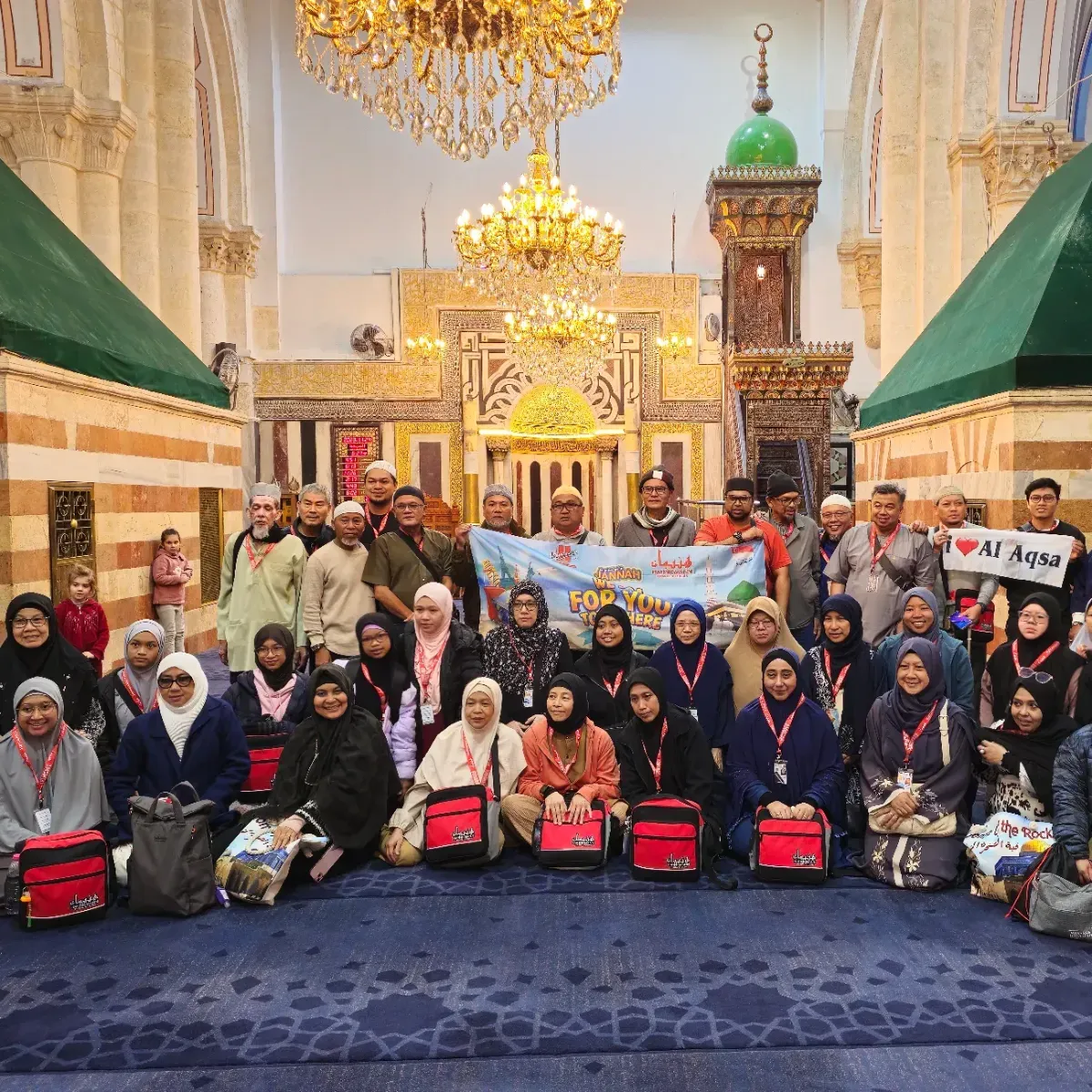
Al Ibrahimi Mosque (Masjid Al Khalil)
Muslim built the Ibrahimi mosqueJews and Christians call it the Tomb or Cave – of the Patriarchs.Four of the most illustrious Prophets and their wives are buried.The four prophets are Ibrahim (عليه السلام), his son Isaaq (عليه السلام), his grandson Yaqoob (عليه السلام) and his great grandson Yusuf (عليه السلام).The other son of Prophet Ibrahim (عليه السلام), Prophet Ismail (عليه السلام), Ibn Kathir reported that the grave of the Prophet Ismail (Ishmael), peace be upon him, is in Makkah.Prophet Ibrahim (عليه السلام) is mentioned by name 69 times in the Quran. He is known as ‘Khalil-ullah’, the friend of Allah.According to the Book of Genesis in the Bible, the land over which the mosque has been built was bought by Ebrahim (عليه السلام) [Abraham] as a family burial plot after the death of Sarah (عليها السلام) [Sara].The plot is named as the ‘Cave of Machpelah’ which means cave of the double tombs, referring to the fact that the wives of the Prophets are buried close to them.It is also known as the ‘Cave of the Patriarchs’.According to most Islamic scholars, the grave of Ibrāhīm (عليه السلام) is within the famous complex of what is now the famous Masjid in Al-Khalil city.The precise location within the complex is not known.Almighty Allah has declared in the Quran in Surah al-Imran, Chapter 3 verse 65 - 68:“O People of the Scripture (Jews and Christians)! Why do you dispute about Abraham, while the Torah and the Gospel were not revealed till after him? Have you then no sense?Verily, you are those who have disputed about that of which you have no knowledge.Why do then dispute concerning that which you have no knowledge?It is Allah Who knows, and you know not.Abraham was neither a Jew nor a Christian, but he was a true Muslim Hanifan (Islamic Monotheism),to worship none but Allah Alone and he was not of the polytheists (he joined none in worship with Allah). Verily, among mankind who have the best claim to Abraham are those who followed him,andthis Prophet (Muhammad) and those who have believed (Muslims). And Allah is the Wali (Protector and Helper) of the believers.”[Al-Qur'an 3:65-68]Imam Scholar Ḥāfiẓ Ibn Kathīr (d. 774/1373) writes that Prophet Ibrahim was buried in a village called Al Khalil and the whole complex should be revered and respected.The Jerusalem geographer al-Muqaddasi, writing in 985 CE described the town as:"In Al Khalil (Hebron) is a public guest house continuously open, with a cook, a baker and servants in regular attendance.These offer a dish of lentils and olive oil to every poor person who arrives, and it is set before the rich, too, should they wish to partake. Most men express the opinion this is a continuation of the guest house of Abraham, however, it is, in fact from the bequest of the sahabI (companion) of the Prophet Muhammed, Tamim-al Dari and others….The Amir of Khurasan…has assigned to this charity one thousand dirhams yearly,…al-Shar al-Adil bestowed on it a substantial bequest. At present time I do not know in all the realm of al-Islam any house of hospitality and charity more excellent than this one.”All three Abrahamic faiths believe this is where Abraham, Isaac, Jacob and their wives are buried inside the Old City of Al Khalil (Hebron)Ibrahimi Mosque falls under the 1997 Hebron Agreement.H1 is under Palestinian control and covers about 80 percent of Hebron, while H2 is under Israeli control, covering the remaining 20 percent which includes the Jewish Tomb of the Patriarchs, the adjoining Muslim Ibrahimi Mosque and the Old City.The agreement stipulated that the Palestinian Authority (PA) would oversee planning and construction for the entire city, including the Ibrahimi Mosque.It is is recognized as a Palestinian World Heritage site by UN cultural agency UNESCO.

Cave of The Seven Sleepers
They slept for 309 years !!! and woke up to find their ENTIRE town had become Muslim." 😱🕋 These weren't prophets. They were ORDINARY YOUTH who chose Allah ﷻ over everything. --- 🌙 THE STORY OF THE 7 SLEEPERS (ASHABUL KAHF) A king demanded they worship idols. They refused. So they fled to a cave & prayed: Surah Al Kahf, Chp 18 verse 10: "Our Lord, grant us from Yourself mercy and prepare for us from our affair right guidance." . . . Allah put them to sleep—for 309 years. When they woke up? - Their enemies were GONE. - Their entire nation had embraced Islam. 💡Moral: - When you choose Allah, HE God Almighty handles the rest.

Prophet Musa Mosque (Maqam Nabi Musa علَيْهِ ٱلسَّلَام)
The exact place where Musa (عليه السلام) is buried is unknown but tradition holds that Salahuddin Ayyubi once had a dream where he was shown this spot. He had a mosque built on the site which was further expanded by Sultan Baybars in 1269 CE. The Maqam is located 11km south of Jericho and 20km east of Al Quds (Jerusalem) Musa (عليه السلام) is mentioned by name 136 times in the Quran, more than any other prophet. A Mamluk inscription at the site reads that ‘The construction of this Maqam over the grave of the prophet who spoke with God, Moses, is ordered by his majesty Sultan Dhaher Abu al-Fatah Baybars, in the year 668 Hijri.’ The building consists of a large central courtyard surrounded by over 120 rooms with the ‘burial chamber’ of Prophet Musa on the right of the mosque which is built against the western wall of the courtyard. Sahih Bukhari, Hadith No 1339: Narrated Abu Huraira: The angel of death was sent to Moses and when he went to him, Moses slapped him severely, spoiling one of his eyes. The angel went back to his Lord, and said, "You sent me to a slave who does not want to die." Allah restored his eye (Angel of Death) and said, "Go back and tell him (i.e. Moses) to place his hand over the back of an ox, for he will be allowed to live for a number of years equal to the number of hairs coming under his hand." (So the angel came to him and told him the same). Then Moses asked, "O my Lord! What will be then?" He (Angel of Death) said, "Death will be then." He (Musa) said, "(Let it be) now." He (Musa) asked Allah that He (Allah) bring him near the Sacred Land at a distance of a stone's throw. Allah's Messenger (ﷺ)said, "IIf i were there, I would show you the grave of Moses by the way near the red sand hill."

Dead Sea
Islamic scholars and historians (such as Ibn Kathir and Al-Tabari),the Dead Sea is the exact site of the ancient cities of Sodom and Gomorrah—the home of the people of Prophet Lut (Lot) (عليه السلام)Because the people rejected the prophetic message and openly engaged in systemic, violent sins and heinous immorality, Allah decreed their total destruction. The Qur'an states:“So when Our command came, We turned the highest part of the city upside down and rained upon them stones of layered hard clay.” (Surah Hud, 11:82)True Muslims should not visit the Dead Sea for leisure or casual tourism.Prophet Muhammad (ﷺ) explicitly commanded his companions when passing by places of past divine wrath:"Do not enter upon these recipients of punishment—unless you are crying—lest you be afflicted with what afflicted them."(Sahih al-Bukhari 3380)(Sahih Muslim 2980)Due to its history of divine chastisement, authoritative scholars strongly advise against using mud, therapeutic salts, or mineral cosmetics sourced from the Dead SeaSheikh Ibn Baz and Sheikh Ibn Uthaymeen advises that if travel through locations like the Dead Sea is unavoidable, one should pass through as quickly as possible with mindfulness rather than for leisure.In Surah Ar-Rum, Allah made a bold historical prophecy regarding the war between the Byzantine (Roman) and Persian Empires.The Persians had completely crushed the Romans in a battle fought in the Greater Syria basin around the Dead Sea. Allah revealed:“The Romans have been defeated in the lowest land (Adna al-Ard).But they, after their defeat, will overcome... within a few years.” (Surah Ar-Rum, 30:2-4)The Scientific Fact:In standard Arabic, the word Adna has two accurate linguistic meanings: nearest or lowest. For over a thousand years, early translators interpreted it as "the nearest land" to Arabia.The Revelation:With the advent of modern satellite topography, geologists discovered that the shores of the Dead Sea rank as the absolute lowest land-based elevation on Earth, sitting at roughly 430 meters (1,412 feet) below sea level.The Challenge to Atheists:The battle took place right at this basin. How could Prophet Muhammad (ﷺ)—an unlettered man living in a desert 1,400 years ago, completely devoid of measuring devices, maps, or geographical surveys—know that this exact region was uniquely the absolute lowest point on the face of the globe?The Qur'an’s specific description of the destruction of Lut's people—stating that the land was "turned upside down"—perfectly reflects the unique geological history of the Dead Sea.The Scientific Fact:The Dead Sea is not a typical ocean body; it is a terminal lake situated directly inside a deep, volatile geologic faultline known as the Jordan Rift Valley.The Evidence:Geological and archaeological studies of the valley show that the area suffered a catastrophic, sudden tectonic drop. The subterranean pressure forced up asphalt, sulfur, and oil, completely plunging the surface topography downward.The phrase "turned upside down" is a flawless literal description of a catastrophic rifting event that dropped the earth's crust to form the world's deepest continental depression.An atheist might counter by claiming that other highly saline lakes exist, such as the Great Salt Lake in Utah or Lake Assal in Africa.While high-salinity lakes occur elsewhere due to natural evaporation, no other place on Earth combines all of the following specific Qur'anic parameters1. It is uniquely the absolute lowest land spot on Earth.2. It is the specific historical battleground defined as Adna al-Ard where the Roman-Persian prophecy was physically fulfilled.3. It preserves explicit geological anomalies (such as continuous subterranean asphalt discharging and hyper-salinity that completely chokes out organic life) acting as an enduring, visible "evident Ayah (sign/warning)" left behind by Allah for future generations to witness.“And indeed, We have left thereof an evident sign for a people who understand.” (Surah Al-’Ankabut, 29:35)

Mosque of Al-Ghamama
Centuries-old stone mosque said to occupy the site where Prophet Muhammad performed the Eid prayer.

Al Baqi Cemetery
Jannatul Baqi is the oldest and most sacred Islamic cemetery in Medina. It holds over 10,000 companions of Prophet Muhammad (PBUH), including many family members and early leaders, with graves marked only by simple stones. 4th Caliph Uthman ibn Affan, Ahl al-Bayt members such as Hasan ibn Ali, daughters Zainab, Rukayya, and Umm Kulthum, along with Imam Zayn al-Abidin, Imam Muhammad al-Baqir, and Imam Ja'far al-Sadiq. Many wives of the Prophet (Aisha, Umm Salama, others) and his aunt Safiyyah are also buried here

Wadi al-Baida (Valley of Jinn)
Wadi al-Baida, locally known as Wadi al-Jinn, is a valley and an anti-gravity hill in al-Baida Park located approximately 30 kilometers northwest of Medina in the Medina Province of Saudi Arabia. It is renowned for a "gravity hill" phenomenon where vehicles in neutral gear appear to move uphill on their own, often attributed to optical illusions or magnetic anomalies.

Railway Museum (Hijaz Railway Museum)
Historic Ottoman train station showcasing antique train cars & relics from Medina's heritage. The station was opened in 1326 AH (1908), and it is one of the railway’s most prominent stations and its nal station. During World War I, the station was intermittently closed until it halted permanently in 1921. The Al-Suqya Mosque is located within the station walls. It was named after the nearby Al-Suqya Well, from which the Prophet Mohammed (ﷺ) performed ablution while heading to the Battle of Badr, prayed, and supplicated for the well-being of the Muslims of Madinah. During his governorship of Madinah, Umar bin Abdul Aziz, may Allah bless his soul, built this mosque on the site where the Prophet (ﷺ) prayed.

The International Fair and Museum of the Prophet's Biography and Islamic Civilization
a world-class interactive museum dedicated to presenting a comprehensive and authentic introduction to the noble life of Prophet Muhammad ﷺ, his values, ethics, and conduct, while highlighting the true message of Islam. The museum is located in the Haram district, adjacent to the Prophet’s Mosque in Madinah, and is supervised by the Muslim World League. It was officially inaugurated on 21 Jumada Al-Akhirah 1442 AH, corresponding to 3 February 2021. The museum houses more than 500 artifacts and crafted pieces related to the Prophetic era, presented through an educational narrative supported by the latest technologies.
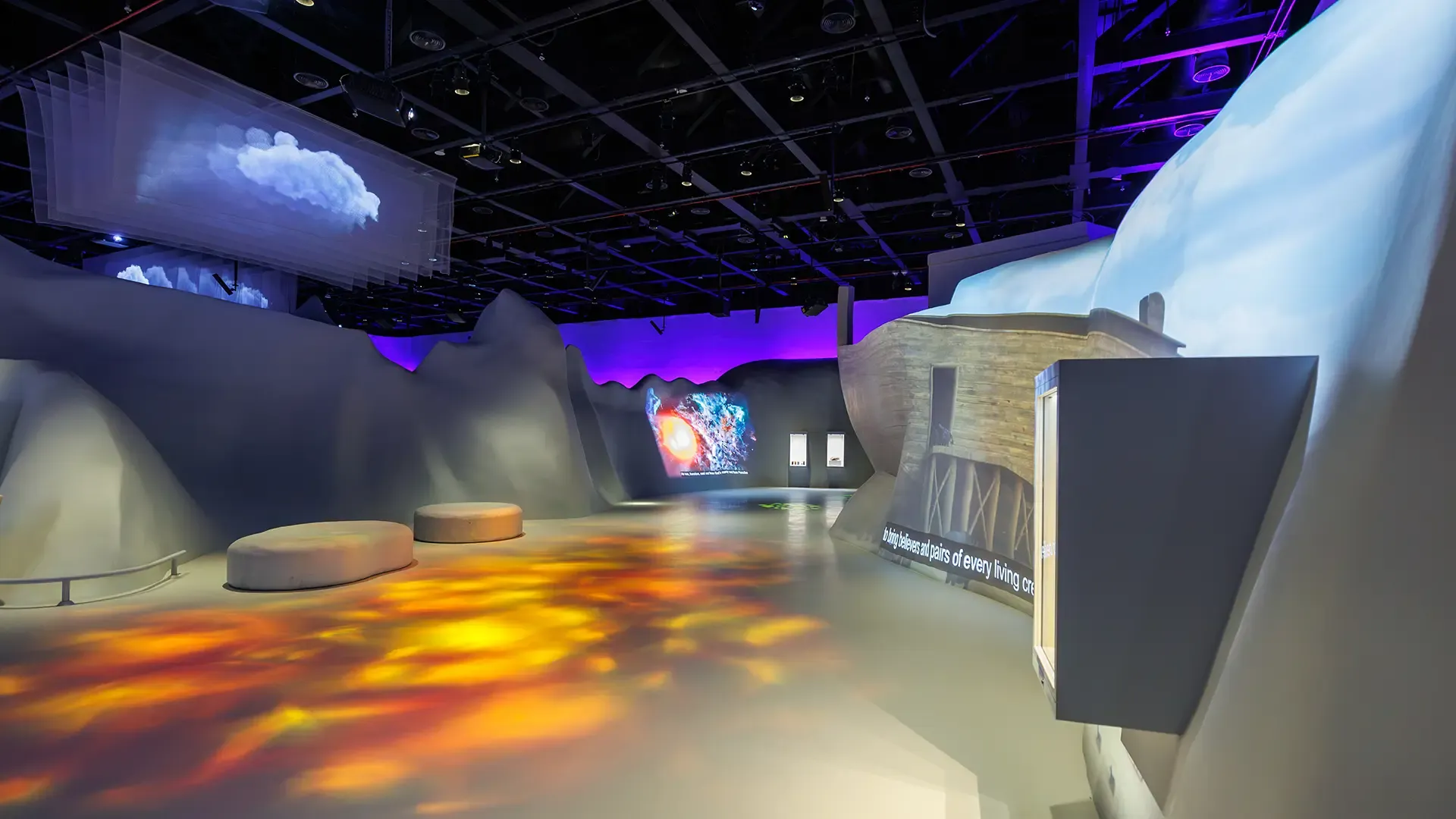
As Safiyyah Museum & Park
Creation Story Museum - A digital museum, located on two floors below the garden in As Safiyyah Park & Museum, deals with the story of creation from the beginning, through the creation of the universe and the sending of the prophets, until the end of the world, through a narrative that juxtaposes the latest display technologies, in a dazzling experience for visitors.
Haramain High Speed Railway Depot (Medina)
The Haramain High Speed Railway (HHR) depot in Medina, completed in 2016, is a major maintenance and operational hub featuring three large buildings, 24 railway tracks across four yards, and specialized workshops. This facility ensures the technical maintenance of trains traveling up to 300km/h between Medina, Mecca, Jeddah, and KAEC.

Haramain Train Station (Makkah)
The Haramain High Speed Railway connects Makkah and Madinah, with stops in Jeddah, supporting the growing demand for efficient transport for pilgrims, visitors, and residents travelling between Saudi’s major cities. Makkah Station A terminal station serving as a key arrival and departure point for travellers between the holy cities, equipped with travel halls, prayer facilities, parking, and commercial services.
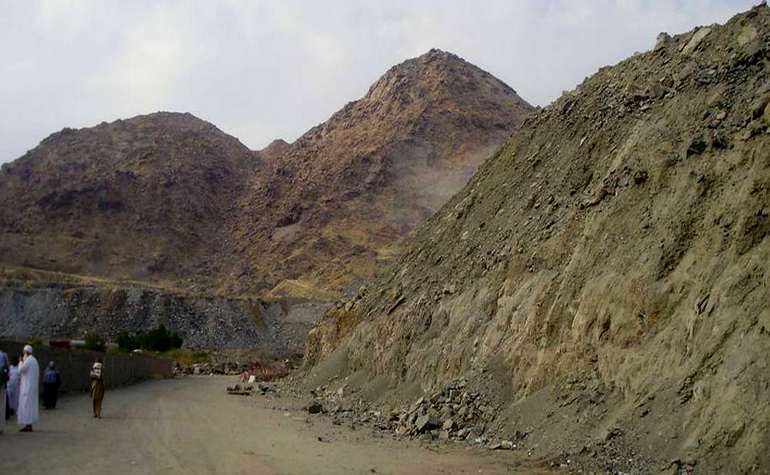
Thowr Mountain (Jabal Thur / Thawr)
Jabal Thawr (Arabic: جَبَل ثَوْر) is a mountain in Saudi Arabia, located in the lower part of Mecca to the south of the district of Misfalah. The mountain is notable for housing a cave known as Ghār Thawr (Arabic: غَار ثَوْر), in which the Islamic prophet Muhammad ﷺ took refuge from the Quraysh, during the migration to Medina. Truth about dove nest and spider web = https://islamqa.info/en/answers/27224/overnight-stay-of-the-prophet-(peace-and-blessings-of-allaah-be-upon-him)-and-abu-bakr-in-the-cave-of-thawr

Masjid Al Nimrah (Masjid Namirah)
Masjid an-Namirah or Masjid Nimrah is a mosque in Wadi Uranah near Mecca in the Hejazi region of Saudi Arabia. • Site of the Farewell Sermon:Masjid Namirah (also spelled Namrah or Nimra) is a historic monument located near the plains of Arafat,- marking the exact location where Prophet Muhammad (ﷺ) pitched his tent,- stood at valley (Batn ‘Uranah) to deliver the Farewell Sermon (Khutbat al-Wida') to over 100,000 companions and led the prayers during his Farewell Hajj in 10 AH.• The Rejection of Pre-Islamic Paganism (Jahiliyyah):- In the immediate vicinity of this valley, pagan Arabs historically held distinct, elitist rituals during the pre-Islamic era.- Tribes who considered themselves elite (Al-Hums) refused to go out to the plains of Arafat like common tribes, staying inside the sanctuary borders instead.- By camping at Namirah and preaching down in the valley of 'Uranah, the Prophet (ﷺ) physically shattered these structural class systems.- He (ﷺ) established a universal standard of equality, declaring on this exact dirt: "An Arab has no superiority over a non-Arab, nor a white over a black, except by piety (Taqwa)."• The "One-Day" Mosque:While it stands as the second-largest mosque in the Makkah province (accommodating up to 400,000 worshippers), it remains empty for virtually the entire year.It springs to life exclusively on the 9th of Dhul-Hijjah (the Day of Arafah) for a single afternoon.• Alternative Historical Names:To demonstrate its profound theological weight, classical historians note that the site has been known by three other major names:1. Masjid Ibrahim al-Khalil (The Mosque of Abraham): (Arabic: مسجد إبراهيم الخليل)- because the Prophet Muhammad's (ﷺ) actions on this exact site were a direct restoration of the original, uncorrupted monotheistic Hajj legacy pioneered by Prophet Ibrahim (peace be upon him) centuries prior.2. Masjid al-Tawbah (The Mosque of Repentance):- Commemorating the mass spiritual clean-slate achieved by the 100,000+ companions who wept and repented together behind the Prophet (ﷺ) on that afternoon.3. Masjid 'Arafah: (Arabic: مسجد عرفة)- Due to its direct visual connection and proximity to the sacred plain.4. Masjid Uranah (Arabic: مسجد عرنة)- because the entire front section of the mosque—including the Mihrab (prayer niche) and the Minbar (pulpit)—is physically located inside Wadi ‘Urana- the name Uranah refers to the valley that sits outside the legal boundaries of Arafat, calling it Masjid Uranah highlights the vital Hajj boundary rule• The Trans-Boundary Dilemma:The mosque possesses a unique geographic layout. The front section sits inside Wadi ‘Uranah (which is outside the legal boundary of Arafat), while the back portion is situated directly within the borders of Arafat.Hahnemann Travel SingaporeWhatsapp +65 9775 2605It also has several other names, including: Masjid Ibrahim al-Khalil (Arabic: مسجد إبراهيم الخليل)Masjid Arafah (Arabic: مسجد عرفة)Masjid Uranah (Arabic: مسجد عرنة)On the Day of Arafat (9th of Dhul Hijjah), Hajj pilgrims travel from Mina to Arafat. After arriving in Arafat, pilgrims gather at Masjid Nimra where the Imam delivers a sermon.

Mount Arafat
The word Arafat is ‘to know’. Arafah (عرفة) is the name of the day, and Arafat (عرفات) is the name of the land. Standing at Arafat land is a fundamental requirement of Hajj on the 9th of Dhul Hiijjah. Whoever misses the standing on Arafat has missed Hajj, because the Prophet (ﷺ) said: “Hajj is Arafat.” [al-Hakim] . The day of Arafat has many virtues, as was narrated in many Ahadith. Aisha (رضي الله عنها) narrated that the Prophet (ﷺ) said: “There is no day in which Allah sets free more souls from the fire of hell than on the day of Arafat. And on that day Allah draws near to the earth and by way of exhibiting His Pride remarks to the angels, ‘What is the desire of these (servants of mine)?'” [Sahih Muslim]
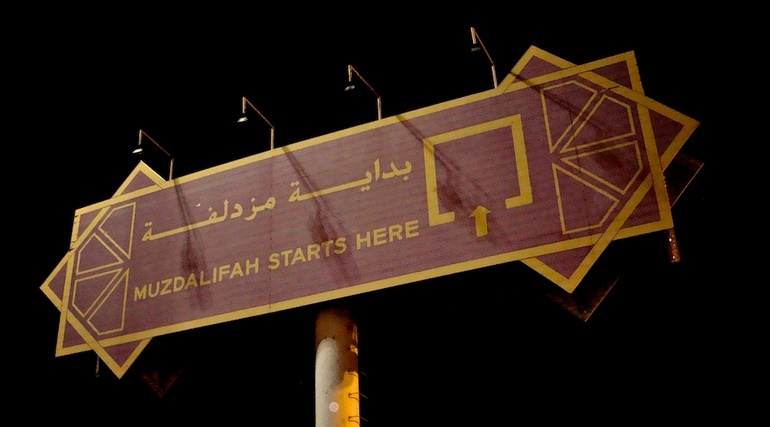
Muzdalifa
Muzdalifah (Arabic: مزدلفة) is an open area located southeast of Mina, on the way between Mina and Arafat. On the 9th Dhul Hijjah (second day of Hajj), pilgrims arrive here after sunset from Arafat and spend the night here.

The Blessed Rawdah - The Green Dome
Garden from the gardens of Paradise, from the Prophet's ﷺ house (the Blessed Chamber) to his pulpit. The Prophet ﷺ says, "Between my house and my pulpit is a meadow of the Paradise." The distance between the pulpit and the blessed chamber is about 26.5 meters. The yellow copper enclosure around the Blessed Chamber obscures part of the Rawdah behind the chamber. So, excluding the detached part, the Rawdah from the pulpit to the copper enclosure is 22 meters long and 15 meters wide.

Jurana Mosque (Masjid Ji'ranah)
Jurana Mosque or Masjid Ji'ranah is written in Arabic as مسجد الجعرانة, where Prophet Muhammad (ﷺ) entered Ihram after the Battle of Hunayn. It is sometimes called Masjid al-Ji'rranah or Masjid Ja'ranah.

Masjid Aisha “Umm al-Mumineen”(Masjid Al-Taneem)
Masjid Aisha عائشة مسجد, where Ummul-Mu’mineen Aisha (رضي الله عنها) went to enter into Ihram. She was instructed to do so by the Prophet (ﷺ) during the Farewell Hajj.. This mosque lies on the edge of Mecca & so is often used to put on Ihram during the Hajj. Masjid Aisha is the closest of all the Miqats (boundary points) of the Haram, the area of Makkah within which certain lawful things are considered unlawful elsewhere. Jaabir (رضي الله عنه) reports that because Aisha (رضي الله عنها) was experiencing menstrual cycle the Prophet (ﷺ) instructed her to perform all the various rites of Hajj except for the tawaf. She then performed the tawaf after her cycle had ended. She then said, “O Rasulullah (ﷺ)! While you have performed Hajj and Umrah, I have performed only Hajj.” The Prophet (ﷺ) then instructed her brother Abdur-Rahman (رضي الله عنه) to take her to Tan’eem and it was from there that she performed her Umrah after her Hajj during the month of Dhul Hijjah.

Changi Airport Singapore
Changi Airport is the main international airport of Singapore, and functions as one of the most significant aviation gateways in the Asia-Pacific region
Golden Tulip Hotel Amman, Jodan
4.7 km from Jordan Gate Towers, Golden Tulip Amman. Wasfi At-Tall St. 126, Amman, Jordan
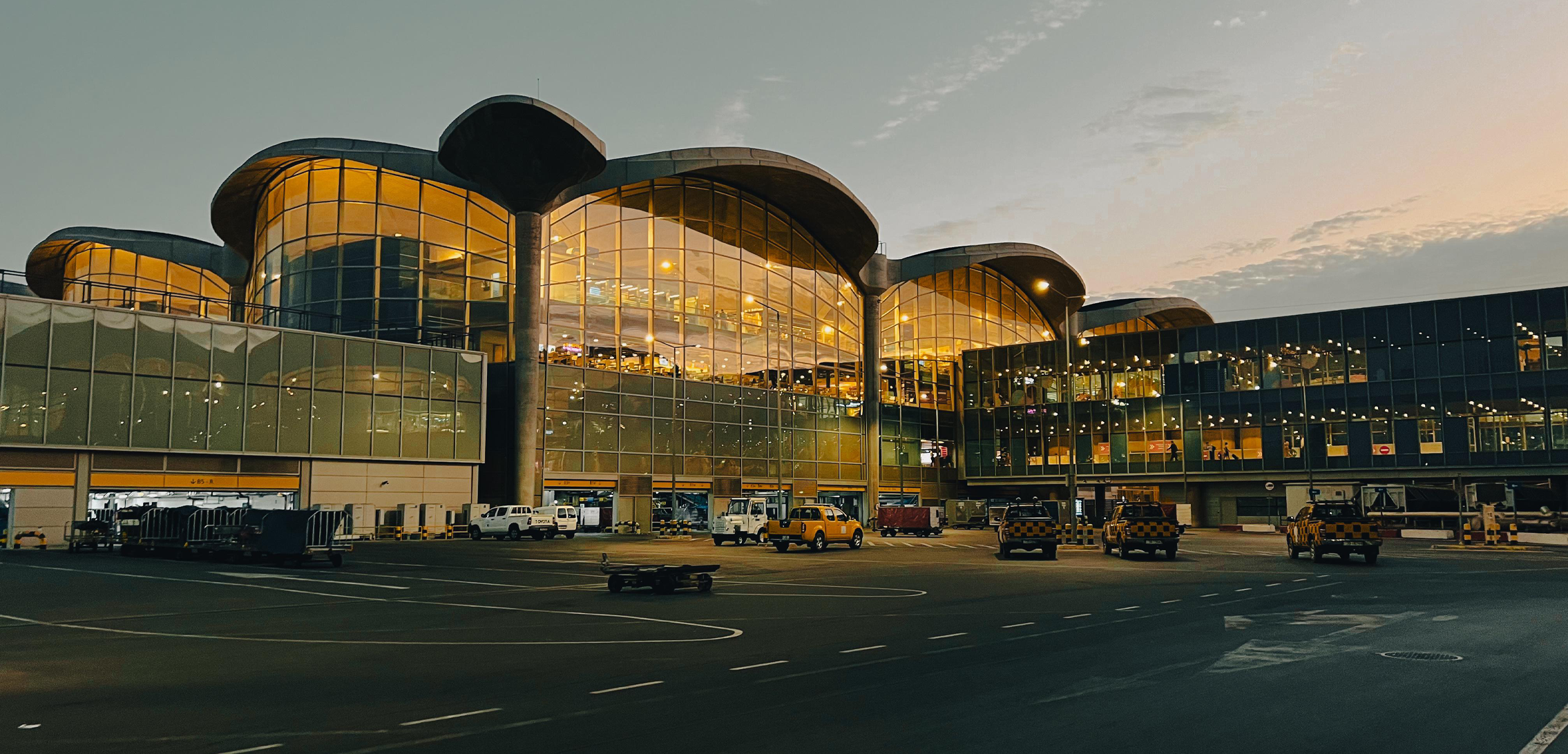
Queen Alia International Airport Amman, Jordan
Located in Zizya, 30 kilometers south of Amman, the capital and largest city of Jordan. Named after Queen Alia, who died in a helicopter crash in 1977.

Mausoleum Jafar Bin Abi Talib Radiyallahu Anhu, Al Mazar, Jordan
Tomb of Jafar-bin-Abi Talib, he was second amir appointed by the Prophet (ﷺ) to lead the Muslim army in the battle of Mu’tah. Jafar (رضي الله عنه) was the paternal cousin of the Prophet (ﷺ) and the older brother of Ali (رضي الله عنه). The Prophet (ﷺ) came out to welcome him and kissed him on his forehead when Jafar returned at the occasion of Khaybar. Rasulullah ﷺ mentioned, “I am not sure whether I am happier with the arrival of Ja’far or with the conquest of Khaybar.” This took place in 7 AH, one year before the battle of Mu’tah. When Zaid (رضي الله عنه) had been killed, the flag of the Muslims was taken by Jafar (رضي الله عنه). He intentionally disabled his horse to dispel any idea of returning home from the battlefield. With flag in one hand and sword in the other, he jumped into the enemy lines. The enemy cut his right hand, which held the flag. He at once transferred it to his left. When that was cut off, he held the flag in his teeth and supported it with his bleeding arms. His body was cut into two by somebody from behind and he fell dead, he was around 33 at the time. It was on this occasion, the Prophet (ﷺ) mentioned, “In Jannah, Allah Ta’ala has given Jafar wings in place of his hands with which he flies around as he wishes and where he wishes”. It is for this reason that he became famously known as Jafar ‘al-Tayaar’ (One who flies).

King Hussein Bridge (Allenby) - Enter & Exit Palestine
A border crossing between Palestine and Jordan, designated for the passage of the Palestinian population, East Jerusalem residents, and foreigners. Sundays through Fridays: 07:30 - 15:30 Saturdays: 07:30 - 17:00 Bridge is informally called the Al-Karameh Bridge (جسر الكرامة) or simply Al-Jisr by Palestinians. It crosses the Jordan River near the city of Jericho in the West Bank and the town of Al-Karameh in Jordan. The bridge is currently the only official border crossing between the West Bank and Jordan, and is the sole designated exit/entry point for West Bank Palestinians travelling abroad by land.

Masjid al Buraq (Buraq Stable)
small structure, on the south-west corner of the al-Aqsa compound is believed to be the place where the Prophet Muhammed (ﷺ) tied the Buraq, the riding animal upon which he rode during the Night of Ascension. The wall on the right is the other side of what the Jews call the Wailing Wall. Sahih Muslim, Hadith No 162: It is narrated on the authority of Anas bin Malik (رضي الله عنه) that the Prophet (ﷺ) said, "I was brought al-Buraq who is an animal white and long, larger than a donkey but smaller than a mule, who would place his hoof a distance equal to the range of vision. I mounted it and came to Bayt al-Maqdis. I tethered it to the ring used by the prophets. I entered the mosque and prayed two rak’ahs in it, and then came out and Jibraeel brought me a vessel of wine and a vessel of milk. I chose the milk, and Jibraeel said: You have chosen the natural thing.” Then he took me to heaven. Gabriel then asked the (gate of heaven) to be opened and he was asked who he was. He replied: Gabriel. He was again asked: Who is with you? He (Gabriel) said: Muhammad. It was said: Has he been sent for? Gabriel replied: He has indeed been sent for. And (the door of the heaven) was opened for us and lo! we saw Adam. He welcomed me and prayed for my good. Then we ascended to the second heaven. Gabriel (peace be upon him) (asked the door of heaven to be opened), and he was asked who he was. He answered: Gabriel; and was again asked: Who is with you? He replied: Muhammad. It was said: Has he been sent for? He replied: He has indeed been sent for. The gate was opened. When I entered 'Isa b. Maryam and Yahya b. Zakariya (peace be upon both of them), cousins from the maternal side. welcomed me and prayed for my good Then I was taken to the third heaven and Gabriel asked for the opening (of the door). He was asked: Who are you? He replied: Gabriel. He was (again) asked: Who is with you? He replied Muhammad (ﷺ). It was said: Has he been sent for? He replied He has indeed been sent for. (The gate) was opened for us and I saw Yusuf (peace of Allah be upon him) who had been given half of (world) beauty. He welcomed me prayed for my well-being. Then he ascended with us to the fourth heaven. Gabriel (peace be upon him) asked for the (gate) to be opened, and it was said: Who is he? He replied: Gabriel. It was (again) said: Who is with you? He said: Muhammad. It was said: Has he been sent for? He replied: He has indeed been sent for. The (gate) was opened for us, and lo! Idris was there. He welcomed me and prayed for my well-being (About him) Allah, the Exalted and the Glorious, has said:" We elevated him (Idris) to the exalted position" (Qur'an xix. 57). Then he ascended with us to the fifth heaven and Gabriel asked for the (gate) to be opened. It was said: Who is he? He replied Gabriel. It was (again) said: Who is with thee? He replied: Muhammad. It was said Has he been sent for? He replied: He has indeed been sent for. (The gate) was opened for us and then I was with Harun (Aaron-peace of Allah be upon him). He welcomed me prayed for my well-being. Then I was taken to the sixth heaven. Gabriel (peace be upon him) asked for the door to be opened. It was said: Who is he? He replied: Gabriel. It was said: Who is with thee? He replied: Muhammad. It was said: Has he been sent for? He replied: He has indeed been sent for. (The gate) was opened for us and there I was with Musa (Moses peace be upon him) He welcomed me and prayed for my well-being. Then I was taken up to the seventh heaven. Gabriel asked the (gate) to be opened. It was said: Who is he? He said: Gabriel It was said. Who is with thee? He replied: Muhammad (may peace be upon him.) It was said: Has he been sent for? He replied: He has indeed been sent for. (The gate) was opened for us and there I found Ibrahim (Abraham peace be upon him) reclining against the Bait-ul-Ma'mur and there enter into it seventy thousand angels every day, never to visit (this place) again. Then I was taken to Sidrat-ul-Muntaha whose leaves were like elephant ears and its fruit like big earthenware vessels. And when it was covered by the Command of Allah, it underwent such a change that none amongst the creation has the power to praise its beauty. Then Allah revealed to me a revelation and He made obligatory for me fifty prayers every day and night. Then I went down to Moses (peace be upon him) and he said: What has your Lord enjoined upon your Ummah? I said: Fifty prayers. He said: Return to thy Lord and beg for reduction (in the number of prayers), for your community shallnot be able to bear this burden. as I have put to test the children of Isra'il and tried them (and found them too weak to bear such a heavy burden). He (the Holy Prophet) said: I went back to my Lord and said: My Lord, make things lighter for my Ummah. (The Lord) reduced five prayers for me. I went down to Moses and said. (The Lord) reduced five (prayers) for me, He said: Verily thy Ummah shall not be able to bear this burden; return to thy Lord and ask Him to make things lighter. I then kept going back and forth between my Lord Blessed and Exalted and Moses, till He said: There are five prayers every day and night. O Muhammad, each being credited as ten, so that makes fifty prayers. He who intends to do a good deed and does not do it will have a good deed recorded for him; and if he does it, it will be recorded for him as ten; whereas he who intends to do an evil deed and does not do, it will not be recorded for him; and if he does it, only one evil deed will be recorded. I then came down and when I came to Moses and informed him, he said: Go back to thy Lord and ask Him to make things lighter. Upon this the Messenger of Allah remarked: I returned to my Lord until I felt ashamed before Him. https://sunnah.com/muslim:162a
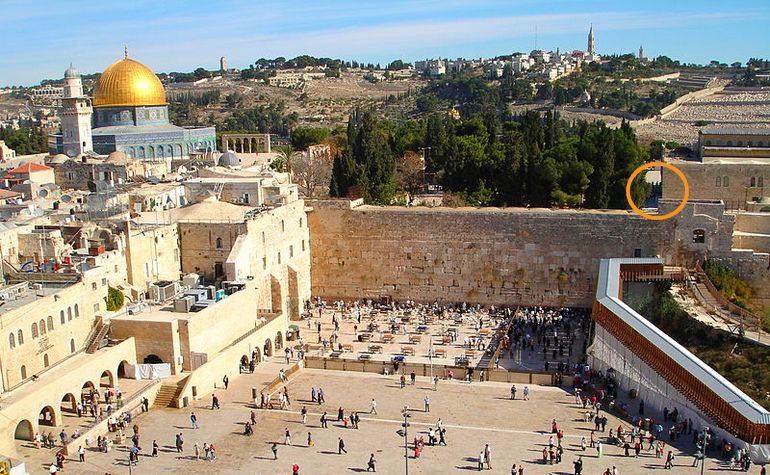
Wailing wall (Western wall)
Remnant of the ancient wall of the Temple courtyard, a sacred site of Jewish prayer & pilgrimage. Formerly referred to as the ‘Wailing Wall’ and now more commonly known as the ‘Western Wall’ is the most sacred place for Jews who believe it to be the only surviving structure of the Herodian temple. Some historians said the Wailing Wall truly is just a remnant a Roman fortress and not the second temple. For Muslims it is known as the Buraq Wall, for on the other side is where the Prophet Muhammed (ﷺ) tied the Buraq, the riding animal upon which he rode during the Night of Ascension (Mi’raj). The circle shows approximately where this happened. Buraq Wall (Ha’it Al-Buraq). During the Prophet Muhammad's ﷺ miraculous Night Journey (Al-Isra' wal-Mi'raj), he rode a celestial steed named Al-Buraq from Mecca to Jerusalem. Tradition holds that he tied Al-Buraq to this exact western wall before entering the compound to lead all previous prophets in prayer and ascending to the heavens. Therefore, Islam considers the entire plaza and its walls to be an integral part of the Al-Aqsa Mosque compound (Al-Haram al-Sharif), making it an entirely Islamic Waqf (endowment) Islamic perspective on the destruction of the Jewish Temples is explicitly detailed in Chapter 17 of the Quran (Surah Al-Isra). The text states that the Children of Israel were decreed to cause corruption on the earth twice, and would be punished twice: "So when the promise came for the first of the two, We sent against you servants of Ours - those of great military might, and they probed [even] into the homes, and it was a promise fulfilled." (Quran 17:5) — Classically interpreted by commentators like Ibn Kathir as the Babylonian destruction. "Then, when the second promise came to pass, [We permitted your enemies] to make your faces sorrowful and to enter the mosque [the sacred site] as they had entered it before, and to destroy with utter destruction what they overtook." (Quran 17:7) — Classically interpreted as the Roman destruction in 70 CE. The Succession of Prophethood: Islam teaches that prophets like David (Dawud) and Solomon (Sulayman) built the initial holy sanctuary to worship the one true God. From an Islamic theological standpoint, when the later generations repeated transgressions and rejected subsequent prophets (such as John the Baptist and Jesus), the spiritual custodianship of the holy site was transferred from the Israelites to the followers of the final prophet, Muhammad ﷺ. the conditional promise of exclusive holy land custody given to the line of Israel was severed due to the continuous rejection and killing of later prophets (such as John the Baptist and Jesus).Therefore, Islamic theology does not anticipate a divinely sanctioned restoration of a Jewish Temple or an end to that specific theological exile. Instead: A Shift in Authority: Islam teaches that when the Jewish nation rejected their final prophets, the inheritance of the holy sites was permanently transferred to the followers of the final prophet, Muhammad. The True "Return": The return of monotheistic worship to the site was fulfilled in the Islamic view when Caliph Omar cleared the ruined Temple Mount in 637 CE and built the Al-Aqsa Mosque compound The Concept of Mipnei Chata'einu (Because of Our Sins): A central theme in Jewish liturgy states, "Because of our sins, we were exiled from our land." In the Torah, God explicitly warns the Israelites in Deuteronomy 28 that while obedience brings blessings, systemic violation of the commandments (Mitzvot) will result in the loss of the land and the scattering of the people.The Cause of the Second Destruction: According to the Talmud (Yoma 9b), the First Temple was destroyed due to three cardinal sins: idolatry, immorality, and bloodshed. However, the Second Temple was destroyed during a period when Jews studied the Torah and performed good deeds. The Talmud attributes its fall to Sinat Chinam—baseless hatred and bitter factional infighting among the Jewish people themselves.The Shechinah (Divine Presence): Jewish mystics teach that when the Temple was destroyed and the people were exiled, the Shechinah (the indwelling presence of God) did not abandon them. Instead, it went into exile with them. Midrashic texts state that the Divine Presence specifically chose never to depart from the Western Wall, making it a permanent spiritual beacon of hope and eventual redemption.The Ban as a Spiritual Boundary: For centuries, rabbinic law placed an internal restriction on entering the Temple Mount. Because the precise location of the Holy of Holies (the innermost sacred chamber) was lost, and the ritual purification required to enter it could no longer be performed, major rabbinic authorities declared it a transgression for Jews to step onto the mount itself. The outer wall therefore became the boundary where they could safely pray without violating this sacred spac

Mosque of Omar (Masjid Omar ibn Al Khattab)
This is where Umar (رضي الله عنه) performed salah after the conquest of Jerusalem by the Muslims in 638 CE. It is near the Church of the Holy Sepulchre. The Patriarch of Jerusalem was showing Umar (رضي الله عنه) around the Church of the Holy Sepulchre during which the time for salah occurred. The Patriarch offered a place for him to pray in the church but Umar (رضي الله عنه) refused, explaining to the Patriarch, “Had I prayed inside the church, the Muslims coming after me would take possession of it, saying that I had prayed in it.” Tradition has it that he picked up a stone, threw it outside and prayed at the spot it landed. The present Mosque of Umar (or Masjid-e-Umar) was built over this place by Salahuddin Ayyubi’s son Afdhal Ali in 1193 CE.

Church of the Holy Sepulchre
The key is held by a man named Adeeb Joudeh Alhusseini. He is Muslim. His family has held those keys for over eight hundred years. The same Muslim family since 1517. Muslims has helped to maintain peace between the many different Christian denominations and be a neutral guardian of the Church of the Holy Sepulchre, since the church is always in tension & split among the many different Christian sects Khalifah Umar (Omar) made an agreement with Sophronius granting Christians freedom and protection so they could worship freely in churches. The two leaders signed a pact popularly called the Pact of Umar, a treaty detailing the rights and privileges of Christians in Jerusalem. Basilica dating to the 4th century that is marked by some Christians as the site of Jesus's tomb. It is where they believe Isa (عليه السلام) [Jesus] was crucified. This concept is rejected by Muslims who believe Isa (عليه السلام) did not die but was taken up to the heavens by Allah (ﷻ) and will return towards the end of time for the second coming. https://www.thearabweekly.com/proud-hold-keys-muslim-christian-coexistence

Prophet Daud Tomb (King David's Tomb)
Tomb or shrine of the Prophet Dawud (عليه السلام) who was from the progeny of Nabi Ya’qoob (عليه السلام) and the father of the Prophet Sulaiman (عليه السلام). It is believed to be a place where Prophet Daud once stayed. In Islam, Dawud (عليه السلام) is regarded as one of the great Prophets, to whom the Zabur (Psalms) were revealed by Allah (ﷻ) a Nabi from the Bani Israa’eel. After the slaying of Jaaloot (Goliath) by Nabi Dawood, the Bani Israa’eel began to love and honour him. Thereafter he became the ruler and also received the mantle of prophethood. Before this, prophethood and rulership were always in two separate families. This was the first time that both were in one family and one person. He was known for his bravery, intelligence, wisdom and accurate judgements. He was assisted with Divine revelation in his judgements. Dawud (عليه السلام) was the first person skilled in making armour from iron. Allah (ﷻ) mentions in Surah Saba in the Holy Quran:| "And certainly We gave Dawud bounty from Us (and said), ‘O mountains! Repeat Our praises with him, and the birds you too’. And we softened for him iron, (saying) ‘Make wide coats of mail, and measure well the links and do righteous deeds. Surely I am Seer of what you do.” [34:10-11] The Prophet (ﷺ) said, “The most loved Salat (prayer) in the sight of Allah is the Salat of Dawud and the most loved of Saum (fasting) in the sight of Allah is the Saum of Dawud. He used to sleep for the first half of the night and offer prayer for one-third of it and sleep (again) for one-sixth of it. And he used to observe fast on alternate days. And when he encountered an enemy he never fled.” [Bukhari] Allah (ﷻ) had given him a very sweet voice such as not had been given to anyone before. When he used to recite the Zabur (Psalms) human beings, jinn, birds and animals stood devotedly listening to him. Dawud (عليه السلام) is mentioned by name 16 times in the Holy Quran. Dawud (عليه السلام) ruled the Children of Israel [Banu Israil] for forty years, seven years in Hebron (al-Khalil) and thirty-three in Jerusalem, which became known as the City of Dawud It is narrated from Sayyidina ibni Abbaas (Radhiyallaahu Anhumaa) that once two people came to Nabi Dawood to settle a dispute over ownership of a bull. Each one claimed ownership and that the other one is the usurper. Nabi Dawood delayed the judgement for the following day. On the next day he called one of them and said to him that “Last night I was instructed through revelation (Wahi) to execute you. Tell me, what is the truth?” This person replied: “O truthful Nabi of Allah! I am completely truthful with regard to the claim on the bull, but a while back I had deceived the other claimant’s father and killed him.” Thereafter Nabi Dawood ordered that this person be executed for the killing. He was always blessed with victory. He always gained victory with a small group of people over large forces. Thus, in a short time, he ruled over vast areas. He was also a great orator and was blessed with an extremely beautiful voice. When he recited the Zaboor, man and Jinn, even animals and birds stopped to listen to his recital. The Taurah served as a code of law for his people. The Zaboor revealed to him did not consist of a new code of law. The Zaboor contained mostly praises of Allah Ta’aala, advices and words of wisdom. It also foretold the advent of Rasulullah (Sallallaahu Alayhi wa Sallam). The Zaboor was revealed on the 12th night of Ramadhaan to Nabi Dawood (Alayhis Salaam). Although he was the king and had treasures at his disposal, he never took anything from the treasury for himself or his family, but earned with his own hands. His miracle was that Allah made steel become soft and flexible in his hands. He would make coats of armour and sell them for an income. He was also gifted with the ability to understand the sounds of the birds. Thus, he would understand the language of the birds. A narration from Sayyidina Abu Hurayrah (Radhiyallaahu Anhu) is recorded in the Hadeeth compilation ‘Mustadrak Haakim’ that after Sayyidina Adam (Alayhis Salaam) was created, his entire progeny was presented to him. Among them he saw a handsome person with a shining forehead. He asked Allah Ta’aala who it is. Allah said that it is a person from among your progeny who will be born much later. He then asked that how long will he live for? The reply was sixty years. He then said that give him another forty years from my lifespan. When it was time for the demise of Sayyidina Adam, the angel of death arrived to take his soul. He said to the angel of death that I still have forty years of life left. The angel said to him: you forgot that you gave forty years of your life to one of your sons Dawood! From this narration it is understood that Nabi Dawood lived for a hundred years. His son Nabi Sulayman (Alayhis Salaam) became the Nabi and ruler after the demise of Nabi Dawood (Alayhis Salaam).
Mount of Olives
The Mount of Olives, East Jerusalem, Palestine, east of the Old City, named for its former olive groves but now a cemetery & has a splendid panoramic view of Masjid Aqsa and Dome of the Rock. Jewish writings (midrash) state that the resurrection of the dead will start on the Mount of Olives when the Messiah arrives. It costs an average of $30,000 - $98,000 or more to be buried in this area to be in line.

Prophet Musa Spring (Moses Spring)
Moses Springs (Ain Musa) where Water Miraculously Gushed from Stone. It is revered as one of the possible sites where the Prophet Moses (عليه السلام) struck a rock with his staff, bringing forth water for the thirsty Israelites during their exodus from Egypt. This natural spring still flows today, enclosed within a simple, three-domed structure that welcomes pilgrims and travelers seeking a tangible connection to one of the Bible’s most enduring miracles. – Biblical Narrative: Associated with the miracle described in Exodus 17:1–7 and Numbers 20:2–13, where Moses provided water in the desert. – Spiritual Pilgrimage: A site of devotion for Christians, Jews, and Muslims alike. – Natural Beauty: The spring flows year-round, offering a serene contrast to the arid landscape. – Proximity to Petra: Just minutes from the entrance to Petra, making it an easy add-on to any visit.
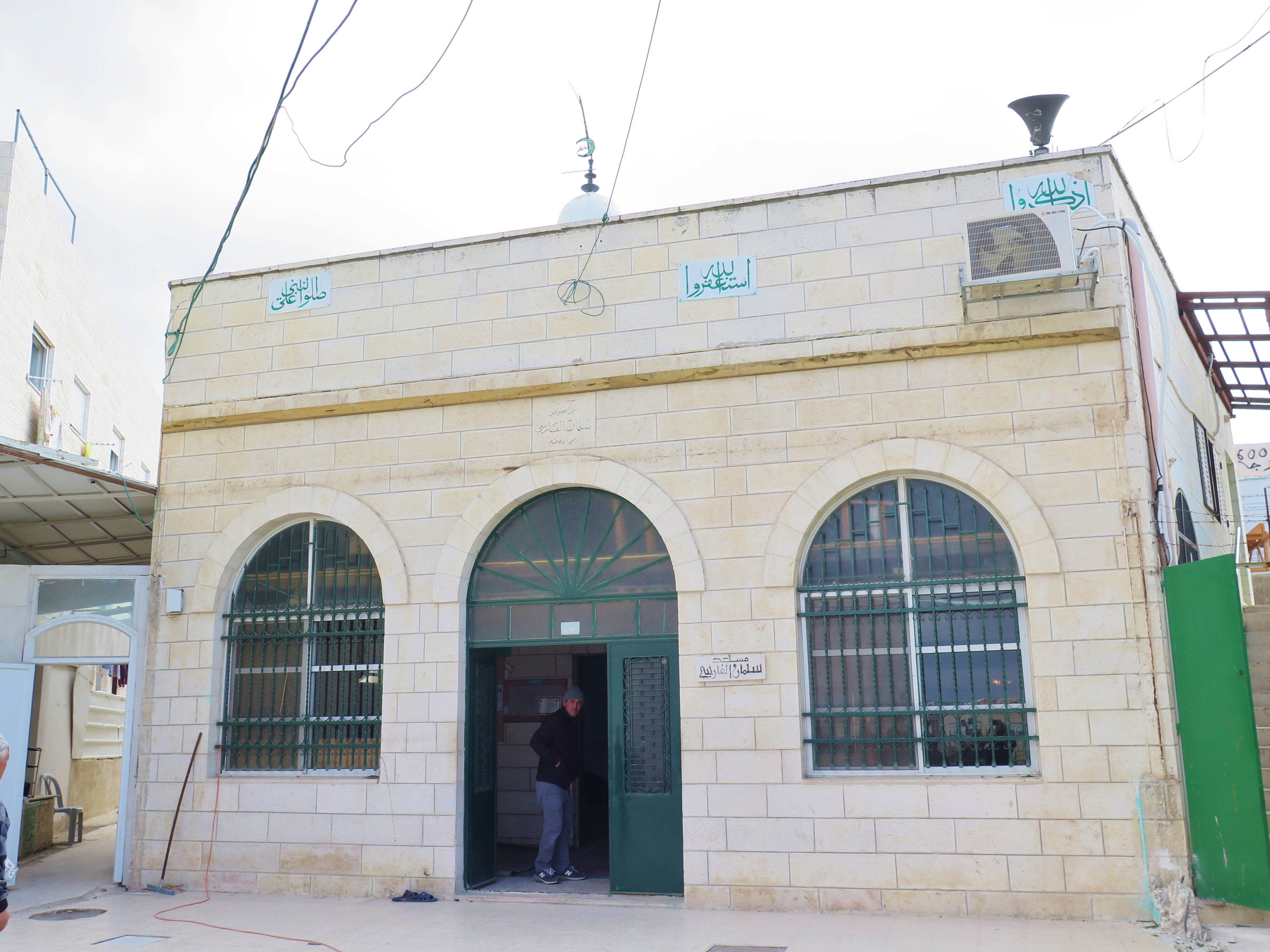
Mosque of Salman Al Farisi (Masjid Salman Al Farisi)
maqam of Salman Farsi (رضي الله عنه), one of the most famous of the Companions of the Prophet (ﷺ) and a great example of a seeker of truth. It marks a place where he once stayed and is located on the Mount of Olives in Al Quds (Jerusalem). Salman Farsi (رضي الله عنه) grew up in Isfahan in Persia into a very rich and respectable family. He was initially a devotee of the Magian religion (fire worshippers).One day his father sent him to a village. On the way he passed by a church from which he heard the Christians praying. He was astonished and remarked to himself, “This is better than our religion”. He asked the Christians about the origins of their faith and was told that it was in ash-Sham (Greater Syria). Upon returning he narrated his experience to his father who became upset and imprisoned him in the house. He managed to escape and joined a caravan to Syria where he sought out the leading bishop, became a Christian and entered into his service in the church. He however, found the bishop to be corrupt and exposed his practises after the bishop’s death. The bishop was replaced by a pious man who was greatly devoted to worship day and night. After his death, Salman attached himself to various Christian religious figures, in Mosul, Nisibis and elsewhere. The last one had told him about the appearance of a Prophet in the land of the Arabs who would have a reputation for strict honesty, one who would accept a gift but would never consume charity (sadaqah) for himself. He would also have the seal of the Prophets on his back. Salman paid money to join a group of Arabs back to their homeland but was betrayed by them and sold into slavery to a Jew who in turn sold him again to another Jew of the Banu Quraiza. He was taken to Yathrib (Madinah) which he recognized to be the place where the awaited Prophet would come. He was put to work there, cultivating and taking care of the palm trees. One day Salman was on top of a palm tree when he heard someone talking with his master below about the emigration from Makkah of a man who claimed to be a Prophet. Salman was excited by the news and asked his master to tell him more but his master violently hit him and told him to get back to work. That evening Salman took some dates and went to Quba, where the Prophet (ﷺ) was staying and offered the dates as sadaqah. The Prophet ordered his companions to eat but he himself did not eat of it. Salman gathered some more dates and when the Prophet (ﷺ) left Quba for Madinah he went to him and said: “I noticed that you did not eat of the sadaqah I gave. This however is a gift for you.” Of this gift of dates, both he and his companions ate. Salman left and returned soon after where he found the Prophet (ﷺ) in al-Baqi. He greeted him and turned to see up his back. The Prophet (ﷺ), knowing what he wanted threw his garment over his shoulder and Salman saw the seal of the Prophets, exactly as it had been described to him. Salman kissed him and embraced Islam. Salman al-Farsi is the companion most widely known for suggesting that Muslims dig a trench to protect Medina during the Battle of Khandaq. The plan was unusual in Arabia, where open fighting was more familiar, but it worked because it blocked the confederates, protected the weak side of the city, and turned a dangerous invasion into a stalled siege.

Chapel of the Ascension
Believed to be the site of Prophet Jesus's ascension to heaven. Allah saved Jesus from his enemies by raising him up to the heavens alive—both body and soul. This is explicitly rooted in the Quran: “And they did not kill him, nor did they crucify him; but it appeared so to them... Rather, Allah raised him to Himself.” -- [Quran 4:157-] Following the Muslim recapture of Jerusalem by Saladin in 1187, the structure was converted into a mosque. It remains under the custody of the Islamic Waqf, but Muslims traditionally permit Christian pilgrims to visit and pray there. The Chapel of the Ascension (on the Mount of Olives) commemorates the ascension of Jesus. Whilst the Dome of the Ascension (Qubbat al-Mi'raj) is an entirely different structure located inside the Al-Aqsa compound. It commemorates Prophet Muhammad’s physical night ascension to the heavens (Al-Mi'raj) Islam physical veneration of specific items like "footprints" or graves with caution to prevent Shirk (associating partners with God). While Muslims respect the historical location as a monument to a major Prophet, the site itself holds no canonical, ritualistic significance in Islamic worship compared to the prescribed mosques

Tomb of Raabi’ah al-‘Adawiyyah (Maqam Rabiatul Adawiyah)
Raabi’ah al-‘Adawiyyah was an ascetic and humble worshipper Her words of asceticism and wisdom, such as when she said to Sufyaan al-Thawri: “You are only a few days, and when one day passes a part of you has gone. Soon, when a part of you have gone all of you will have gone. You know about this, so act upon it.” Another example of the things she said is: “I seek forgiveness from Allaah for the lack of my sincerity when I say, I seek the forgiveness of Allaah.” ‘Abdah bint Abi Shawwaal, who was one of the best female slaves of Allaah and who used to serve Raabi’ah, said: “Raabi’ah used to pray all night long, and just before dawn, she would take a short nap until dawn came. When she awoke with a start, I would hear her say in a terrified manner, ‘O my soul, how long will you sleep? How long will you nap? Soon you will sleep a sleep from which you will not wake until the Day of Resurrection.’” She [‘Abdah] said: this was her habit all her life, until she died. Born in 714 A.D in Basra (Iraq), where she spent the greater part of her life. She was born in the poorest of homes,Her father already had three daughters, and so she was called Rabia (the fourth). She never married, once a man desired to marry her. She replied by thanking him for his proposal and said that she has no room in her heart for any other love besides God. She used to keep her kafan with her all the time. Her place of prostration used to get wet with her tears. All her extraordinary and astonishing ways are quite well known. She is also known as Rabi'ah Basriyyah It was said that she lived for eighty years and died in the year 180 AH. Note: Rabiatul Adawiyah and Huldah are not the same person. They are two distinct historical and religious figures who lived in completely different eras,
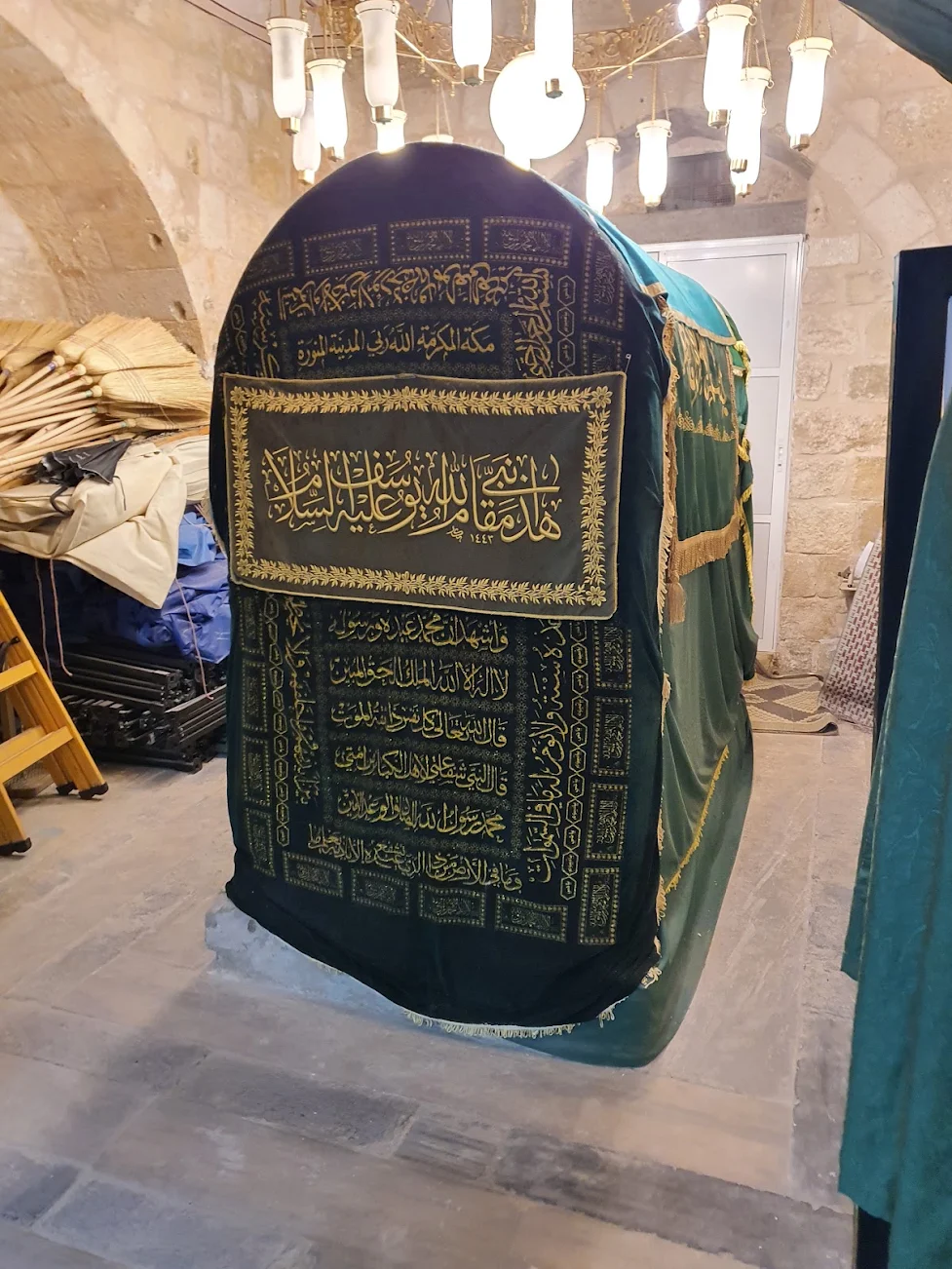
Tomb of Prophet Yusof (عليه السلام) - Basement of Al Ibrahimi Mosque (Masjid Al Khalil)
According to some sources, it also houses the tomb of Prophet Yusof / Yusuf (عليه السلام) (Joseph).The ambiguity is reflected in Islamic tradition which points to Nablus as being the authentic site, though some early Islamic geographers identified the Cave of the Patriarchs in Hebron as housing Prophet Yusof's (عليه السلام) tomb.Le Strange 2010, p. 325:"The tomb of Joseph is in the plot of ground lying outside Solomon's enclosure (the Haram).It stands opposite the tomb of Jacob and is near that of his forefathers Abraham and Isaac. Now Ibrahim ibn Ahmad al Khalanji states that he was requested by one of (the Caliph) Al Muktadir's women, Al ’Ajûz by name, who was sojourning at the Holy City, to proceed to the place where, according to the tradition, Joseph was buried, and having discovered the sepulchre, to erect over it a building.So Al Khalanji set forth with workmen, and they found the place where, according to tradition, Joseph was buried, namely outside the enclosure (of Solomon), and opposite the tomb of Jacob, and they bought the field from its owner, and began to lay it bare. In the very place indicated by the tradition they came on a huge rock, and this, by order of Al Khalanji, was broken into.They tore off a portion, 'and,' says Al Khalanji, 'I being with the workmen in the trench when they raised up the fragment, lo! Here lay (the body of) Joseph – peace be upon him! – beautiful and glorious to look on, as he is always represented to have been.Now, first there arose from the place an odour of musk. I caused the workmen to set it down into its place against the fragment of rock, to be as it has been before.' 'And afterwards,' Mujir ad Din continues, 'they built over this place the Dome which can be seen there to this day, in proof that the tradition is a true one, and that the Patriarch is buried beneath.'The general site is called Al Qala’ah (The Castle)."
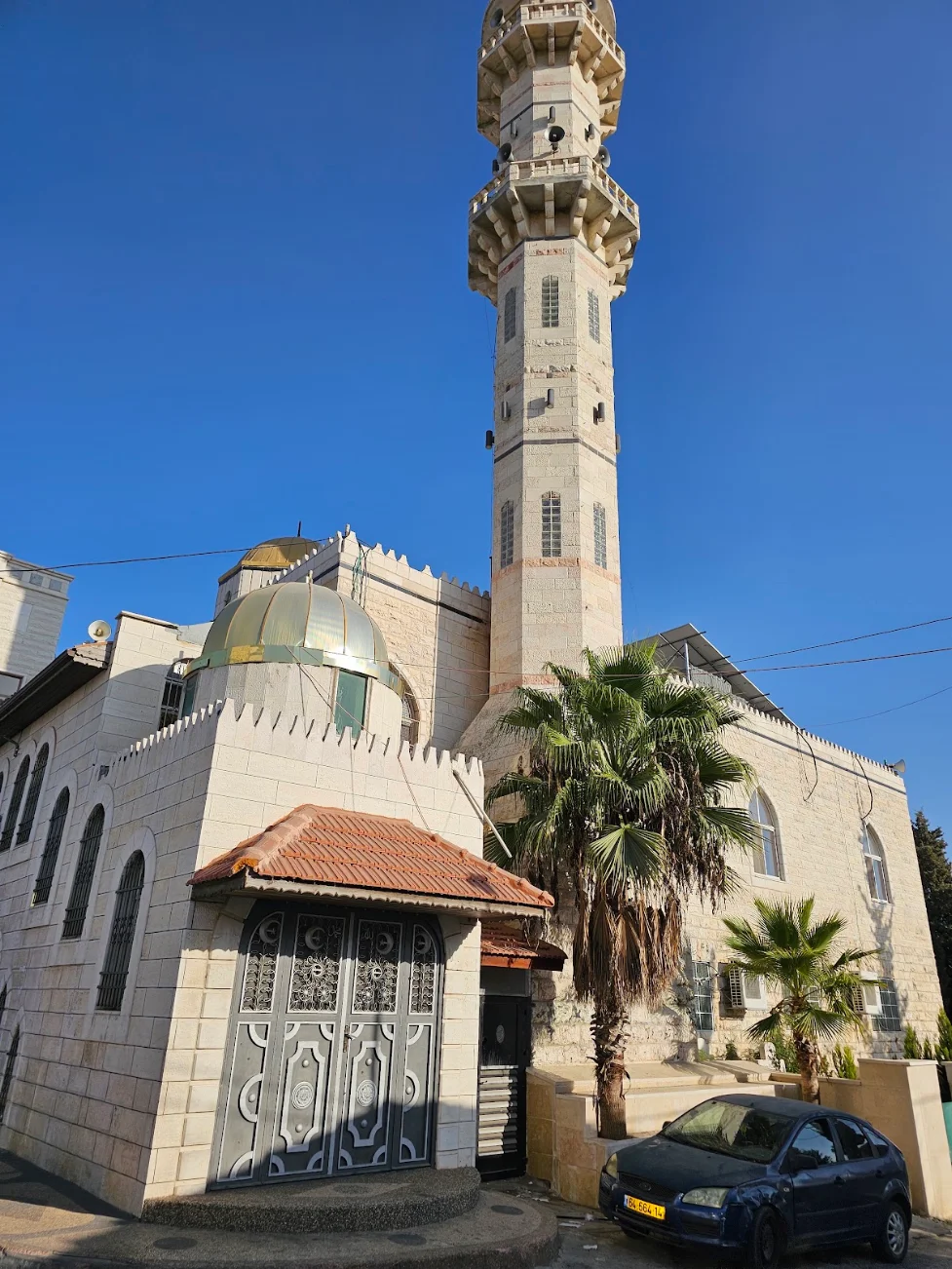
Masjid Nabi Yunus / Yunos (عليه السلام)
Mosque of Prophet Yunus / Yunos (عليه السلام) in Halhul, West Bank, Palestine. It is north of Hebron.Prophet Yunus (عليه السلام) is also addressed by two other surnames “Dhun-Nun” (Lord of the Fish) and “Sahibil-Hot” (Companion of the Fish).When Prophethood was conferred upon Yunus ibn Matta (عليه السلام), Allah commanded him to go to Nineveh (located in the region of Mosul, Iraq) to preach Tawhid (the absolute Oneness of God).Nineveh was a sprawling, prosperous city situated across the river Tigris. Its inhabitants had lapsed heavily into paganism, idolatry, and sinful transgressions.Scholars emphasize that Prophet Yunus did not abandon his duties out of a simple lack of desire to preach. He spent an extensive period patiently calling his people to the truth, but they continuously mocked his warnings and rejected his message.Eventually, knowing that divine law dictates the downfall of persistent deniers, Yunus (عليه السلام) explicitly warned his people that Allah’s severe punishment would descend upon them within three days.As a Prophet of God, he knew that the arrival of this divine wrath was an absolute certainty.Sensing the immediate proximity of the impending torment, he quickly fled the city to avoid being caught in the destruction.Scholars note his error was a matter of timing; he assumed he was free to leave because the threat of destruction was imminent, rather than waiting a moment longer for explicit, divine permission to evacuate.Following his exit, he traveled to the ancient port town of Jaffa (Yafa) in Palestine, where he boarded a packed sailing vessel. The ship was bound for Tarshish.While classical Arabic geographical accounts and historical literature occasionally identify ancient Tarshish with regions as far as Tunisia (or parts of the Western Mediterranean), its exact ancient location remains a subject of historical debate.During this rough sea voyage, a violent storm arose. The crew cast lots to lighten the ship's load, and Yunus (عليه السلام) was chosen, thrown overboard, and subsequently swallowed by a massive fish (whale) by Allah's command.While inside the triple darkness of the fish's belly, Yunus (عليه السلام) realized his haste and turned back to his Lord in profound repentance. He constantly recited the celebrated supplication found in Surah Al-Anbiya [21:87]As recorded by Ibn Abi Hatim and cited in classical Tafsir literature (such as Tafsir Ibn Kathir), this sincere prayer resonated powerfully.When the angels beneath the Throne heard it, they recognized the voice and said,"O Lord! A faint, familiar voice from a strange, distant land."Allah replied,"Do you not recognize it?"They said,"No, O Lord, who is it?"Allah responded,"It is My servant, Yunus."Because of his continuous remembrance of Allah during times of ease, Allah answered his plea during his time of distress, and commanded the fish to cast him safely back onto the shore.The Quran says:“And (mention) Dhun-Nun when he went off in anger and deemed that We had no power over him but he cried out in darkness, saying: There is no god save Thee.There is no god ˹worthy of worship˺ except You. Glory be to You! I have certainly done wrong.”[21:87]So be patient with your Lord’s decree, and do not be like ˹Jonah,˺ the Man of the Whale, who cried out ˹to Allah˺, in total distress [68:48]It was built by the Ayyubids in 1226 CE around the Mount Nabi Yunus (Jabal Nabi Yunus), which is the highest peak in the West Bank.https://myislam.org/prophet-yunus/https://seekersguidance.org/answers/islamic-belief/did-the-prophet-yunus-sin-when-he-left-his-people/https://burujacademy.com/blog/prophet-yunus-story-jonah/https://islamqa.org/hanafi/seekersguidance-hanafi/85841/did-the-prophet-yunus-sin-when-he-left-his-people/
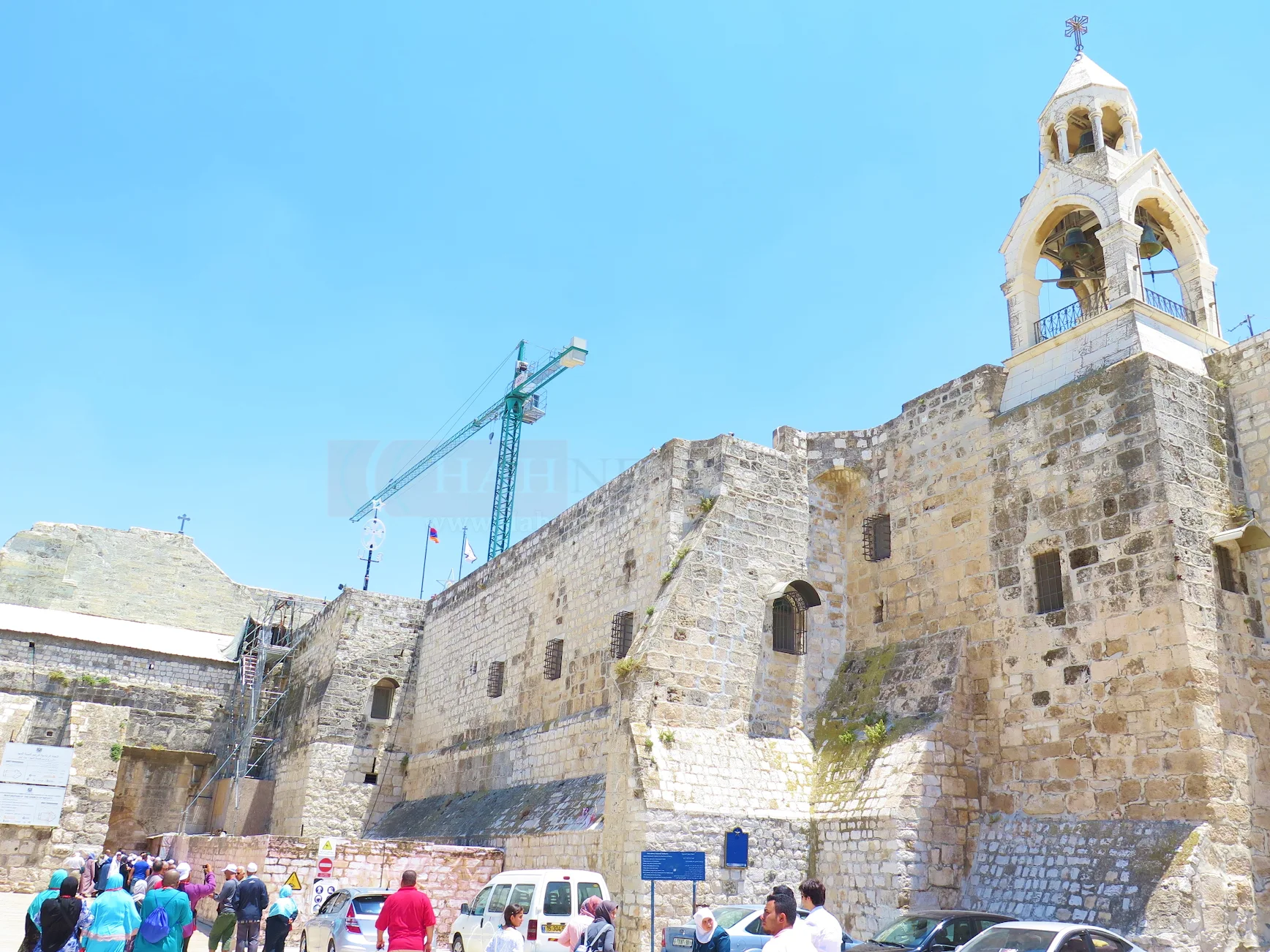
Church of the Nativity
Linguistic history and Christians here where Prophet Jesus (Isa) was born, and even the Bible here in Arabic / Aramaic refers to God as Allah.A direct evolution from the ancient Semitic roots El and Ilah as also found in the Bible but many modern day Christians do not know it is in the books.The earliest disciples of Prophet Jesus and Christian followers recognized the Messiah by his true original name = Isa (Eesa).Which aligns with the Eastern Syriac form Eesho and the Hebrew Yeshua.Classical historical records prove that Christian Arab communities utilized this name centuries prior to Islam.For example, historical sites like the 'Isaniyah monastery in Southern Syria date back to 571 CE, standing as a tangible testament that the name Isa was actively used by early Christians long before the Prophethood of Muhammad (ﷺ).Authentic Islamic data proves that no human being knew the exact location of his birth, as Maryam (عليها السلام) deliberately went into total, unmapped isolation, guided and assisted exclusively by the Angel Jibril (Gabriel)The Holy Qur'an outlines that Maryam's pregnancy and labor took place completely removed from human habitation. In Surah Maryam [19:22–23], Allah states:“So she conceived him, and she withdrew with him to a remote place (Makānan Qasiyyā). And the pains of childbirth drove her to the trunk of a palm tree.”"Makānan Qasiyyā" (A Distant/Remote Place): Classical commentators like Ibn Kathir and modern scholars on IslamQA explain that Qasiyyā denotes a place completely cut off, far away, and isolated from her family and society.Fearing the slander of her people, she fled into the wilderness completely on her own.The text explicitly mentions her settling by a wild, solitary palm tree and being granted a miracle stream.This describes an open, natural desert or valley wilderness—not a crowded, established town center, cave-dwelling, or communal innMaryam (عليها السلام) was not accompanied by any human midwife, family member, or spouse.When she was driven to the point of immense physical and emotional exhaustion—crying out, “Oh, I wish I had died before this and had become a forgotten thing”—her assistance came solely from the unseen realm:“Then he called her from below her, 'Do not grieve; your Lord has provided beneath you a stream.And shake towards you the trunk of the palm tree, it will drop upon you ripe, fresh dates.'”(Surah Maryam [19:24–25])Scholars highlight two major authentic opinions regarding who "called her from below":1. The Angel Jibril (Gabriel): He was stationed at the base of the slope, comforting her, striking the ground with his wing to manifest a fresh stream of water, and instructing her on how to sustain herself.2. The Infant Isa (عليه السلام): Speaking as a newborn miracle to reassure his mother.In either authentic narration, the event was entirely hidden from human eyes. As reliably recorded by early classical scholars and historians, when Maryam conceived, she went into complete isolation at a distant place out of habitation.By the time her guardian, the Prophet Zakariyya (عليه السلام), and her relatives realized she was missing and went out into the wilderness to search for her, she had already given birth to Prophet Isa cleanly under the divine protection of Allah and His angels.Because Maryam fled entirely alone into an unpopulated, distant valley, the exact geographic coordinates of the palm tree were never documented or witnessed by human society.Some Islamic historical reports casually associate the general geographic region of the birth with the "Bethlehem Valley" (about 4 to 6 miles from Jerusalem), the construction of a specific shrine or church building centuries later remains a human approximation.A marble floor or a specific cave basement cannot be authenticated as the "exact spot," because it directly bypasses the explicit Qur'anic reality:Prophet Isa’s birth was a completely hidden, protected divine miracle, taking place in a nameless, remote wilderness away from the knowledge of mankind.The Qur'anic narrative of Prophet Isa (عليه السلام) as a purely human Messenger of God is deeply interconnected with early, Christian movements and Jewish-Christian history. (Before the Council of Nicea)Early Christianity followers and immediate disciples (Al-Hawariyyun) who walked, ate, and lived alongside Prophet Isa had absolutely no doubt regarding his humanity.The radical distortion of his teachings was driven heavily by political maneuvering, Roman authority, and the theological changes introduced by Paul.Paul, who originally persecuted early Christians, actively opposed James (referred to in text as the "cousin" or brother of Jesus) and the original disciples who strove to keep the true teachings of the Injil (Gospel of Isa) intact.The Bible itself records the massive friction between Paul and the Jerusalem Church.In Acts 21:20–24, the early leaders confronted Paul over rumors that his heinous teachings were urging people to completely forsake the Law of Moses.To prove his loyalty and quiet the allegations, they commanded him to undergo a public purification rite and sponsor a Nazarite vow.Despite these corrections, political forces eventually allowed Paul’s theology to gain the upper hand.Centuries later, under the influence of the Roman Emperor Constantine, these deviations were officially codified at the Council of Nicea (325 CE).Driven by a greed for imperial power, the Roman church integrated existing pagan concepts from Greco-Roman, Egyptian, and Persian mythologies, inventing and canonizing the doctrine of the Trinity (Holy Father, Son, and Ghost).This Trinity corrupted concept was radically different and not known at all to Prophet Isa (عليه السلام) and his true disciples,effectively obscuring his original monotheistic message and ultimately leading to the alteration of his name and teachings.Thus the original teaching of the Injil (Gospel of Isa) was lost.The Gospels we have today is not even from Prophet Isa (Jesus) (عليه السلام), but gospel according to Mark, Luke, John, etc whom the writers and authors are literally unknown and cannot be verified even till today.While Allah allowed these historical shifts to occur to expose the continuous deceptions of man and the devil, He sent the Holy Qur'an as the final, unalterable revelation and a lesson for humankind until the Last Day.Islam acts as a direct, powerful correction to these historical deviations.The Qur'an honors his mother Maryam (Mary) and Prophet Isa (عليه السلام) immensely, validating all of his miraculous signs—such as speaking from the cradle, healing the blind, and raising the dead.However, it explicitly states that these acts occurred solely by the permission and power of Allah, completely rejecting any inherent divinity within Prophet Isa himself.Islam fundamentally confirms the miraculous virgin birth of Prophet Isa (عليه السلام) without a biological father,viewing it as a profound demonstration of Allah's absolute power rather than proof of godhood. As Allah explicitly states:As Allah explicitly states in the Qur'an:"The similitude of 'Eesa (Jesus) before Allah is as that of Adam; He created him from dust, then said to him: 'Be.' And he was." (Surah Ali 'Imran, 3:59)On the Day of Judgment, the Qur'an notes that Isa will completely disavow any claims to divinity,confirming that his only command to his people was to worship Allah alone.Remarkably, this exact reality is mirrored within the compilation of books in the modern Bible.In Matthew 7:21–23, Jesus explicitly prophesies that he will disavow those who perform mighty works in his name while abandoning the divine law:"Not everyone who says to me, 'Lord, Lord,' will enter the kingdom of heaven, but the one who does the will of my Father who is in heaven.On that day many will say to me,'Lord, Lord, did we not prophesy in your name, and cast out demons in your name,and do many mighty works in your name?'And then will I declare to them, 'I never knew you; depart from me, you workers of lawlessness (iniquity).'"https://www.pfandercenter.org/blog/articles/the-origins-of-the-name-isahttps://digitalcommons.lmu.edu/cgi/viewcontent.cgi?article=1057&context=saysomethingtheological
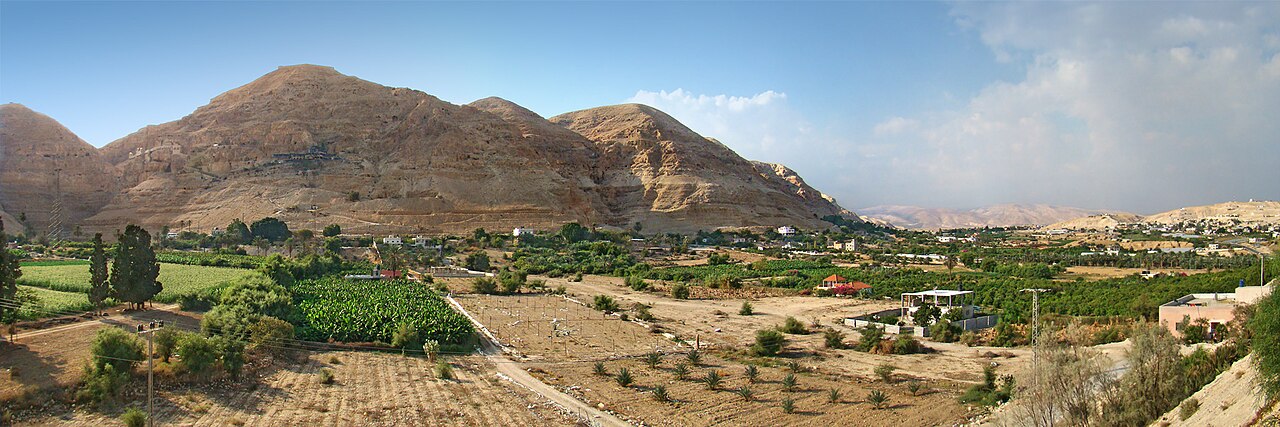
Mount of Temptation / Jabal Quruntul
The Mount of Temptation, in Arabic “جبل التجربة” (Jabal al-Tajriba), also known as Jabal Quruntul is a mountain overlooking the city of Jericho in the West Bank, Palestine.There is no authentication (as the Original Injil given by Allah to Prophet Jesus ﷺ is lost) where the modified Bible accounts that after the devil tempted Prophet Jesus at this place after fasting for 40 days.We call upon Christians who believe in Jesus to return to fastingAuthentic scholarly commentary, "those before you" directly includes the previous nations and their respective Prophets. Classical records indicate that Prophet Musa (Moses) fasted for 40 days on Mount Sinai, Prophet Dawud (David) famously fasted on alternate days (the beloved Siyam Dawud), and Prophet Isa (عليه السلام) spent extensive periods fasting in absolute devotion to Allah.Allah confirms the timeless nature of fasting in the Holy Qur'an:O you who believe! Fasting is prescribed for you as it was prescribed for those before you, that you may become righteous." (Surah Al-Baqarah, 2:183)The modern biblical texts themselves record that Jesus fell on his face and prostrated in prayer (Matthew 26:39), did not eat or drink during his fasts, and preached strict monotheism. Leviticus 23:27–32:“Now on the tenth day of this seventh month is the Day of Atonement... and you shall afflict yourselves and present a food offering to the Lord...For whoever is not afflicted on that very day shall be cut off from his people.”In ancient Hebrew, the command to "afflict your soul" (anah nephesh) specifically meant a total fast from food and water from evening to evening.Whenever a major disaster or divine wrath loomed, the Prophets immediately ordered the entire population to fast. In the Book of Joel 1:14, the Prophet commands the elders of Israel:“Consecrate a fast; call a solemn assembly. Gather the elders and all the inhabitants of the land to the house of the Lord your God, and cry out to the Lord.”“And when you fast, do not look gloomy like the hypocrites... But when you fast, anoint your head and wash your face...”When the Pharisees questioned Jesus about why his immediate disciples were not fasting as strictly as the disciples of John the Baptist, Jesus gave a precise prophecy concerning the period after his earthly departure (Mark 2:20):"The days will come when the bridegroom is taken away from them, and then they will fast in that day.”This verse establishes that once Prophet Isa (عليه السلام) was raised up to the heavens, true Christians were scripturally obligated to resume absolute fasting.Book of Acts confirms that the early apostolic church strictly followed this prophetic command. They relied on fasting to seek divine direction and to appoint leadership:Acts 13:2–3: “While they were worshiping the Lord and fasting, the Holy Spirit said, 'Set apart for me Barnabas and Saul...' Then after fasting and praying they laid their hands on them and sent them off.”Acts 14:23: “And when they had appointed elders for them in every church, with prayer and fasting they committed them to the Lord...”Early Christian historical documents (such as the Didache, dating back to the late 1st century), the earliest Christians fasted strictly twice a week (on Wednesdays and Fridays), mimicking the traditional Semitic style of complete food and drink abstinenceHowever, over centuries of Romanization and institutional evolution, the church watered down these requirements. The grueling 40-day absolute fast modeled by Jesus in the wilderness was re-legislated by church councils into Lent—shifting from a total fast to structural rules where followers merely abstain from red meat, chocolate, or social media.The original Injil—the pure, monotheistic divine scripture revealed directly by Allah to Prophet Isa (عليه السلام)—was historically lost, altered, and replaced by human-authored biographical accounts centuries later. While Islam explicitly affirms that Satan tries to whisper to humans, Muslim scholars emphasize that the Prophets of Allah possess 'Ismah (divine infallibility) and are entirely protected from being overcome, physically transported, or swayed by the devil.
![Mosque of Prophet Jethro [Nabi Syuaib / Shoaib / Shoayb (عليه السلام)]](https://hahnemanntravel.com.sg/storage/city-highlights/dfd7a146-ea87-4b8c-8cb0-a3132e6cc31f.webp)
Mosque of Prophet Jethro [Nabi Syuaib / Shoaib / Shoayb (عليه السلام)]
Maqam of Nabi Shuaib / Shoaib / Jethro (عليه السلام), located near Al-Salt in Jordan, features a large prayer hall and a modern complex surrounding a massive tomb traditionally attributed to the Prophet.One of the Four Arab Prophets:Authoritative scholars note that Shuaib (عليه السلام) is one of only four ethnically Arab Prophets sent by Allah, along with Hud, Salih, and Muhammad (ﷺ).Historical Timeline:He was a descendant of Prophet Ibrahim (Abraham) (عليه السلام). He lived after the destruction of the people of Lut (Lot) (عليه السلام) and prior to the mission of Prophet Musa (Moses) (عليه السلام).The Mission to MadyanThe Economic Highway: Allah sent Shuaib (عليه السلام) to the people of Madyan (Midian), a wealthy merchant community occupying a strategic trade route connecting Yemen, Greater Syria, Iraq, and Egypt.The Sins of Madyan:Beyond their structural paganism and rejection of Tawhid, they pioneered systemic financial corruption.They were notorious for highway robbery, ambushing trading caravans, and cheating in weights and measures (giving short measure to buyers while taking full measure for themselves).He was the first Prophet in recorded human history whose core message explicitly tied spiritual worship (Tawhid) directly to commercial law and market ethicsWhen he commanded his people to fix their corrupted financial scales, his wealthy elite mocked him by asking if his prayers had any right to dictate what they did with their own money (Surah Hud, 11:87).Scholars emphasize that his story serves as a timeless reminder that a person's financial integrity is an inseparable metric of their religious devotion.The Punishment:Despite Shuaib's warnings, the elite rejected his call, threatened to expel him, and accused him of being bewitched.Allah destroyed the corrupt society through a sequence of divine wraths: a suffocating heatwave, a deafening blast (As-Sayhah), and a catastrophic earthquake that left them dead in their homes.While most defiant ancient civilizations in the Qur'an faced a single cataclysmic event (like a flood or wind storm), the people of Madyan were struck by three distinct, overlapping phases of divine retribution due to the sheer variety of their continuous sins:• The Suffocating Heatwave:Allah subjected the city to a relentless, unendurable heatwave for seven straight days, drying up all their water sources.• The Torment of the Canopy (Adhab ad-Dullah):Seeking relief, the citizens spotted what looked like a massive, cool, shading cloud passing over their valley and rushed out beneath it. Instead of rain, the cloud burst, raining down fire, molten rocks, and intense lightning strikes.• The Earthquake and Shriek (As-Sayhah):Simultaneously, a deafening cosmic blast shook the valley, triggering an earthquake that left the deniers lifeless inside their homes.Prophet Shuaib is explicitly mentioned by name 11 times in the text of the Holy Qur'an. His mission is outlined in detail across several chapters, including:• Surah Al-A'raf [7:85]:"And to Madyan, We sent their brother Shuaib. He said: 'O my people! Worship Allah; you have no other deity but Him. Verily, a clear proof from your Lord has come unto you; so give full measure and full weight, and wrong not men in their things...'"• Surah Hud [11:84-95]:Documents his lengthy dialogue, their mockery of his prayer, and their eventual destruction.• Surah Ash-Shu'ara [26:176-189]:Refers to his people as the Companions of the Wood (Ashab al-Aykah) due to their worship of a massive, sacred forest tree.The Bible Implies Jethro was originally a pagan priest who only recognized the true God after hearing of Moses' Exodus miracles (Exodus 18:11: "Now I know that the Lord is greater than all gods"). Islamic narrative clarifies that "Jethro" was a righteous monotheistic Messenger whose story was altered over centuries of biblical manuscript copying into a localized narrative about an ethnic priest,whereas the Qur'an preserves his true global legacy as a champion of economic equity and Tawhid.
Wadi D Fajr
Activities:Visitors can ride Arabian horses, play Sepak takraw and practice traditional archery, which includes options for horseback archery.Animal Interactions:The site offers camel riding and allows guests to feed and interact with various local farm animals, sheeps, cats etc.Date Palm Climbing:Guests have the opportunity to experience climbing traditional date palm trees.Southeast Asian Cuisine:To cater to international pilgrims, the area features food stalls serving familiar Malaysian dishes such as Roti Canai, Nasi Lemak, Mee Goreng, and Teh Tarik.Historical Proximity:It provides a convenient leisure break situated right next to the historically significant grounds of Hudaibiyah.
Al Hudaibiyyah Mosque
• The Location of the Treaty:Masjid al-Hudaibiyah (also known today as Masjid al-Shumaisi) marks the exact historical location where the landmark Treaty of Hudaibiyah (Sulh al-Hudaibiyah) was signed in 6 AH (628 CE) between Prophet Muhammad (ﷺ) and the pagan Quraysh elite.• The Scene of the Pledge of Ridwan:Beneath an acacia tree at this very spot, 1,400 to 1,500 companions placed their hands over the Prophet's (ﷺ) hand, swearing an absolute oath of allegiance to fight to the death.This happened after false rumors circulated that Uthman ibn Affan (رضي الله عنه) had been assassinated inside Makkah while serving as an envoy.• A "Clear Victory" Declared by Allah:Though the treaty's physical terms originally seemed humiliating to some companions—such as delaying their Umrah and returning to Madinah—Allah revealed the opening of Surah Al-Fath right after leaving the valley, proclaiming the peace treaty to be a Fath Mubin (Clear Victory).The truce allowed Islam to spread rapidly in times of peace, directly paving the way for the bloodless conquest of Makkah two years later.• The Site of a Grand Prophetic Miracle:Hudaibiyah was the location of a famous water miracle. Faced with a completely dried-out well and an army crying out from intense thirst, the Prophet (ﷺ) rinsed his mouth into the well and supplicated, causing water to gush forth until the entire army and all their animals were satisfied.• Modern Legal Function as a Miqat:Beyond its historical status, the location serves an active legal purpose in Islamic jurisprudence today.It sits right on the boundary line of Adna al-Hill (the nearest edge outside the sacred sanctuary).For residents or pilgrims already inside Makkah who wish to make a subsequent or secondary Umrah, it acts as a valid Miqat to enter the state of Ihram before traveling back to the Kaaba.• The Trees of Allegiance:Scholars point out an important lesson in preventing polytheistic innovations (Bida').During the Caliphate of Umar ibn al-Khattab (رضي الله عنه), he noticed that some Muslims began traveling to Hudaibiyah specifically to seek blessings (Tabarruk) from the tree where the pledge took place.Fearing this would degenerate into idol worship, Umar ordered the tree to be cut down, setting a legal precedent that physical landmarks are preserved for historical reflection, not spiritual veneration.• The Miqat Demarcation Rule:Authoritative fatwas reiterate that if a person is traveling from Jeddah toward Makkah to perform Umrah, Hudaibiyah sits on their path.If they pass it without entering into the state of Ihram despite having the intention, they must physically travel back out to the boundary line to make amends, or else offer a sacrificial sheep in Makkah to rectify their error.• Preserving the Ruins:The site features two structural elements:the ruins of the older, stone Abbasid-era mosque built near the well, and the modern, active mosque complex functioning right beside it for modern pilgrims.Definitive Hadith and Reference LinksThe detailed operational events of the caravan setting out, the she-camel Al-Qaswa' refusing to move, and the water miracle are captured across the canonical books on Sunnah.com:• The Comprehensive Treaty Context:The long, primary narration containing the complete political negotiations with Suhail ibn Amr and the caravan's arrival at the valley is found in Sahih al-Bukhari 2731, 2732(The Book of Conditions / كتاب الشروط).• The Prophetic Well Miracle:The eyewitness testimony of the companions drawing endless water from the dry pit after the Prophet (ﷺ) blessed it is indexed under Sahih al-Bukhari 3577(The Book of Virtues and Merits / كتاب المناقب).• The Virtue of the Companions:The declaration protecting those who stood at Hudaibiyah from the fires of hell is highlighted in the collections on Daily Hadith Online (Hudaybiyyah),mapping back to the Prophet’s words:"None of the companions who gave the pledge of allegiance under the tree at Hudaybiyyah will enter the Hellfire."
Jumeirah Jabal Omar Makkah
Plush rooms, some with views of the Grand Mosque, in a sleek hotel with a Mediterranean restaurant.
Maden Taiba Premium 5*Hotel | فندق مادن
Maden Taiba Premium 5* Hotel Madinah — est 80metres to Masjidil Nabawi VIP services, dining, and amenities at Maden Hotel. Pinnacle of luxury at Maden Hotel.
Masjid Nabawi
The Prophet's Muhammad ﷺ Mosque is the second mosque built by Rasulullah ﷺ after the Quba Mosque. It is the second holiest site in Islam, after the Masjid al-Haram in Mecca. Every prayer is Masjidil Nabawi is multiplied by 1000x !It also houses the Gardens of Paradise (Ar Rawdah / Raudah) on earth.Sahih Bukhari, Hadith No 1190:Allah's Messenger (ﷺ) said,"One prayer in my Mosque is better than one thousand prayers in any other mosque excepting Al-Masjid-AI-Haram."-https://sunnah.com/bukhari:1190...Sahih Bukhari, hadith No 1196:The Prophet (ﷺ) said,"Between my house and my pulpit there is a garden of the gardens of Paradise (Rawdah),and my pulpit is on my fountain tank (i.e. Al-Kauthar)."-https://sunnah.com/bukhari:1196...Sahih Bukhari, Hadith No 1189:The Prophet (ﷺ) said,"Do not set out on a journey except for three Mosques i.e. Al-Masjid-AI-Haram, the Mosque of Allah's Messenger (ﷺ) ,and the Mosque of Al-Aqsa, (Mosque of Jerusalem)."-https://sunnah.com/bukhari:1189...Sahih Bukhari, Hadith No 1871:Allah's Messenger (ﷺ) said,"I was ordered to migrate to a town which will swallow (conquer) other towns and is called Yathrib and that is Medina,and it turns out (bad) persons as a furnace removes the impurities of iron.-https://sunnah.com/bukhari:1871...Sahih Bukhari, Hadith No 1876:Allah's Messenger (ﷺ) said,"Verily, Belief returns and goes back to Medina as a snake returns and goes back to its hole (when in danger).-https://sunnah.com/bukhari:1876Madinah is the gathering-point of the Muslims in the beginning and at the end. An-Nawawi (may Allah have mercy on him) said:“Faith will retreat to Madinah” – what is meant is that this is how faith is in the beginning and at the end, because at the beginning of Islam, everyone whose faith was sincere and whose Islam was valid came to Madinah, either as a Muhajir (migrant) coming to settle there, or out of a longing to see the Messenger of Allah (ﷺ),andto learn from him and be near to him; then after that, at the time of the caliphs, people did the same, so they came to learn about the straight path from them and follow the example of the majority of the Companions (may Allah be pleased with them) living there;then after that, they came to learn from the scholars of Madinah who were a shining lamp of that era, and the Imams of guidance, to learn Islam and the Sunnah of the Messenger of Allah (ﷺ) that the Companions narrated to subsequent generations….Therefore everyone who was steadfast in faith and at ease with it would travel there. “(Sharh An-Nawawi ‘Ala Muslim, 2/177).Sahih Bukhari, Hadith No 1877:I heard the Prophet (ﷺ) saying,"None plots against the people of Medinabutthat he will be dissolved (destroyed) like the salt is dissolved in water."-https://sunnah.com/bukhari:1877...
Masjid Quba
Spiritual pilgrimage site thought to date from the prophet Muhammad’s time in the 7th century CE.
Salman Al Farsi Farm
Uhud Mountain
Imposing, rocky ridge & site of the 624 CE Battle of Uhud between the Meccan army & early Muslims.
Masjid al-Qiblatayn
Twin-towered mosque where the prophet Muhammad redirected prayer from Jerusalem to Mecca in 624.
The Seven Mosques (Khandaq Mosque)
Striking place of worship with twin minarets backed by rugged cliffs, the site of an ancient battle.
Masjid al-Haram
Known as the Great Mosque of Mecca, is a mosque in Mecca, Saudi Arabia, serving as the holiest and most important mosque in Islam.
Alamoudi Museum | متحف العمودي
Jamrah Al Aqabah Al-Kubra
Petra, Jordan
The city of Petra (Red Rose City), the capital of the Nabataeans. Iconic 2000-year-old city, including 45m-high Al Khazneh (The Treasury), carved into the red mountain rock. 120 km north of the Red Sea town of Aqaba, one of the seven wonders of the world! Surah Al Hijr, Chapter 15 verse 80 - 83 "The people of the Rock also rejected the messengers. We gave them Our revelations, but they turned away from them. They used to carve homes in the mountains, feeling secure. But the ˹mighty˺ blast overtook them in the morning."
Al-Aqsa Mosque
Masjid al-Aqsa is not only the Qibly mosque (with the silver/black dome). It is in fact the whole region including the Dome of the Rock where it is the 3rd holiest Mosque in Islam (any prayer done within this area is a multiplication of 250x and other hadith is 500x each prayer). Also known as Bayt al-Maqdis or Bayt al-Muqaddas (House of the Holiness). The name ‘Masjid al-Aqsa’ translates as ‘the farthest mosque’ and is the third most holy place in Islam. It was here that in around 621 CE the Prophet Muhammed (ﷺ) came on the night journey from Makkah riding on the Buraq. Sahih Bukhari, Hadith No 3366: Narrated Abu Dhar: I said, "O Allah's Messenger (ﷺ)! Which mosque was first built on the surface of the earth?" He ﷺ said, "Al- Masjid-ul-,Haram (in Mecca)." I asked, "Which was built next?" He ﷺ replied "The mosque of Al-Aqsa ( in Al Quds [Jerusalem]) ." I asked, "What was the period of construction between the two?" He ﷺ said, "Forty years." He ﷺ added, "Wherever (you may be, and) the prayer time becomes due, perform the prayer there, for the best thing is to do so (i.e. to offer the prayers in time). https://sunnah.com/bukhari:3366 . . . The first qiblah for Muslims; The station of al-Isra and al-Mi’raj; The second house of Allah built on earth; The place where hundreds of Messengers of Allah (ﷻ) are buried; The place where many Sahabah are buried; A place where miracles were shown by Allah’s will; A place which Allah (ﷻ) Himself calls a ‘blessed place’; Referred to directly and indirectly, 70 times in the Quran; The place where angels have descended with Allah’s message; The only place on earth where all the Messengers of Allah prayed at the same time led by the Prophet Muhammed (ﷺ) The only Masjid mentioned by name in the Quran apart from the Ka’bah Most religious Jews regard entry into the al-Aqsa compound (which they call the Temple Mount) as a violation of Jewish law. This restriction is based on the belief that even though the Temple (of Solomon) was destroyed centuries ago, the precise location of the Holy of Holies, the sanctuary that was once entered by the High Priest, is not known. Hence the restriction is applied to the entire compound. They believe that the Temple should only be built after the coming of their Messiah, and it is their belief that it would be presumptuous of people to force God’s hand. However, there are several Jewish groups who differ from this opinion. Many Evangelical Christians consider it to be a prerequisite to Armageddon and the Second Coming (of Jesus), and both are actively encouraging the rebuilding of the Temple on the Aqsa ground. There are ten open gates leading in and out of Masjid al-Aqsa. Nine of these are can be used by Muslims, the exception is the Moroccan Gate (Bab al-Magharib) which is solely for non-Muslims to enter from. Masjid al-Aqsa has 25 wells within its compound.
Dome of the Rock
The Dome of the Rock (Qubbatus Saqqara or Masjid Sakhara) is actually part of Masjid al-Aqsa compound. This structure was built by Caliph Abd al-Malik from 685 to 692 CE and houses the sacred rock or cave from which it is believed the Prophet Muhammed (ﷺ) ascended to heaven (Mi’raj) after the night journey to Jerusalem (Isra’). Some scholars believe that the angel Israfeel (عليه السلام) will blow the soor (trumpet) from this place to herald the Day of Judgement. When the Dome of the Rock was originally built, there was a surplus of 100,000 gold dinars left from the budget. Caliph Abd al-Malik decided to have these dinars melted down and turned into plates to cover the dome. Almost 400 years later, the dome was severely damaged by an earthquake and the plates were replaced by blackened lead. In 1994 King Hussein donated the money to have it replaced with the gold plated metal we see today. The dome is topped by a full moon decoration which is aligned so that if you could look through it, you would be looking straight towards Makkah.
Al Ibrahimi Mosque (Masjid Al Khalil)
Muslim built the Ibrahimi mosqueJews and Christians call it the Tomb or Cave – of the Patriarchs.Four of the most illustrious Prophets and their wives are buried.The four prophets are Ibrahim (عليه السلام), his son Isaaq (عليه السلام), his grandson Yaqoob (عليه السلام) and his great grandson Yusuf (عليه السلام).The other son of Prophet Ibrahim (عليه السلام), Prophet Ismail (عليه السلام), Ibn Kathir reported that the grave of the Prophet Ismail (Ishmael), peace be upon him, is in Makkah.Prophet Ibrahim (عليه السلام) is mentioned by name 69 times in the Quran. He is known as ‘Khalil-ullah’, the friend of Allah.According to the Book of Genesis in the Bible, the land over which the mosque has been built was bought by Ebrahim (عليه السلام) [Abraham] as a family burial plot after the death of Sarah (عليها السلام) [Sara].The plot is named as the ‘Cave of Machpelah’ which means cave of the double tombs, referring to the fact that the wives of the Prophets are buried close to them.It is also known as the ‘Cave of the Patriarchs’.According to most Islamic scholars, the grave of Ibrāhīm (عليه السلام) is within the famous complex of what is now the famous Masjid in Al-Khalil city.The precise location within the complex is not known.Almighty Allah has declared in the Quran in Surah al-Imran, Chapter 3 verse 65 - 68:“O People of the Scripture (Jews and Christians)! Why do you dispute about Abraham, while the Torah and the Gospel were not revealed till after him? Have you then no sense?Verily, you are those who have disputed about that of which you have no knowledge.Why do then dispute concerning that which you have no knowledge?It is Allah Who knows, and you know not.Abraham was neither a Jew nor a Christian, but he was a true Muslim Hanifan (Islamic Monotheism),to worship none but Allah Alone and he was not of the polytheists (he joined none in worship with Allah). Verily, among mankind who have the best claim to Abraham are those who followed him,andthis Prophet (Muhammad) and those who have believed (Muslims). And Allah is the Wali (Protector and Helper) of the believers.”[Al-Qur'an 3:65-68]Imam Scholar Ḥāfiẓ Ibn Kathīr (d. 774/1373) writes that Prophet Ibrahim was buried in a village called Al Khalil and the whole complex should be revered and respected.The Jerusalem geographer al-Muqaddasi, writing in 985 CE described the town as:"In Al Khalil (Hebron) is a public guest house continuously open, with a cook, a baker and servants in regular attendance.These offer a dish of lentils and olive oil to every poor person who arrives, and it is set before the rich, too, should they wish to partake. Most men express the opinion this is a continuation of the guest house of Abraham, however, it is, in fact from the bequest of the sahabI (companion) of the Prophet Muhammed, Tamim-al Dari and others….The Amir of Khurasan…has assigned to this charity one thousand dirhams yearly,…al-Shar al-Adil bestowed on it a substantial bequest. At present time I do not know in all the realm of al-Islam any house of hospitality and charity more excellent than this one.”All three Abrahamic faiths believe this is where Abraham, Isaac, Jacob and their wives are buried inside the Old City of Al Khalil (Hebron)Ibrahimi Mosque falls under the 1997 Hebron Agreement.H1 is under Palestinian control and covers about 80 percent of Hebron, while H2 is under Israeli control, covering the remaining 20 percent which includes the Jewish Tomb of the Patriarchs, the adjoining Muslim Ibrahimi Mosque and the Old City.The agreement stipulated that the Palestinian Authority (PA) would oversee planning and construction for the entire city, including the Ibrahimi Mosque.It is is recognized as a Palestinian World Heritage site by UN cultural agency UNESCO.
Cave of The Seven Sleepers
They slept for 309 years !!! and woke up to find their ENTIRE town had become Muslim." 😱🕋 These weren't prophets. They were ORDINARY YOUTH who chose Allah ﷻ over everything. --- 🌙 THE STORY OF THE 7 SLEEPERS (ASHABUL KAHF) A king demanded they worship idols. They refused. So they fled to a cave & prayed: Surah Al Kahf, Chp 18 verse 10: "Our Lord, grant us from Yourself mercy and prepare for us from our affair right guidance." . . . Allah put them to sleep—for 309 years. When they woke up? - Their enemies were GONE. - Their entire nation had embraced Islam. 💡Moral: - When you choose Allah, HE God Almighty handles the rest.
Prophet Musa Mosque (Maqam Nabi Musa علَيْهِ ٱلسَّلَام)
The exact place where Musa (عليه السلام) is buried is unknown but tradition holds that Salahuddin Ayyubi once had a dream where he was shown this spot. He had a mosque built on the site which was further expanded by Sultan Baybars in 1269 CE. The Maqam is located 11km south of Jericho and 20km east of Al Quds (Jerusalem) Musa (عليه السلام) is mentioned by name 136 times in the Quran, more than any other prophet. A Mamluk inscription at the site reads that ‘The construction of this Maqam over the grave of the prophet who spoke with God, Moses, is ordered by his majesty Sultan Dhaher Abu al-Fatah Baybars, in the year 668 Hijri.’ The building consists of a large central courtyard surrounded by over 120 rooms with the ‘burial chamber’ of Prophet Musa on the right of the mosque which is built against the western wall of the courtyard. Sahih Bukhari, Hadith No 1339: Narrated Abu Huraira: The angel of death was sent to Moses and when he went to him, Moses slapped him severely, spoiling one of his eyes. The angel went back to his Lord, and said, "You sent me to a slave who does not want to die." Allah restored his eye (Angel of Death) and said, "Go back and tell him (i.e. Moses) to place his hand over the back of an ox, for he will be allowed to live for a number of years equal to the number of hairs coming under his hand." (So the angel came to him and told him the same). Then Moses asked, "O my Lord! What will be then?" He (Angel of Death) said, "Death will be then." He (Musa) said, "(Let it be) now." He (Musa) asked Allah that He (Allah) bring him near the Sacred Land at a distance of a stone's throw. Allah's Messenger (ﷺ)said, "IIf i were there, I would show you the grave of Moses by the way near the red sand hill."
Dead Sea
Islamic scholars and historians (such as Ibn Kathir and Al-Tabari),the Dead Sea is the exact site of the ancient cities of Sodom and Gomorrah—the home of the people of Prophet Lut (Lot) (عليه السلام)Because the people rejected the prophetic message and openly engaged in systemic, violent sins and heinous immorality, Allah decreed their total destruction. The Qur'an states:“So when Our command came, We turned the highest part of the city upside down and rained upon them stones of layered hard clay.” (Surah Hud, 11:82)True Muslims should not visit the Dead Sea for leisure or casual tourism.Prophet Muhammad (ﷺ) explicitly commanded his companions when passing by places of past divine wrath:"Do not enter upon these recipients of punishment—unless you are crying—lest you be afflicted with what afflicted them."(Sahih al-Bukhari 3380)(Sahih Muslim 2980)Due to its history of divine chastisement, authoritative scholars strongly advise against using mud, therapeutic salts, or mineral cosmetics sourced from the Dead SeaSheikh Ibn Baz and Sheikh Ibn Uthaymeen advises that if travel through locations like the Dead Sea is unavoidable, one should pass through as quickly as possible with mindfulness rather than for leisure.In Surah Ar-Rum, Allah made a bold historical prophecy regarding the war between the Byzantine (Roman) and Persian Empires.The Persians had completely crushed the Romans in a battle fought in the Greater Syria basin around the Dead Sea. Allah revealed:“The Romans have been defeated in the lowest land (Adna al-Ard).But they, after their defeat, will overcome... within a few years.” (Surah Ar-Rum, 30:2-4)The Scientific Fact:In standard Arabic, the word Adna has two accurate linguistic meanings: nearest or lowest. For over a thousand years, early translators interpreted it as "the nearest land" to Arabia.The Revelation:With the advent of modern satellite topography, geologists discovered that the shores of the Dead Sea rank as the absolute lowest land-based elevation on Earth, sitting at roughly 430 meters (1,412 feet) below sea level.The Challenge to Atheists:The battle took place right at this basin. How could Prophet Muhammad (ﷺ)—an unlettered man living in a desert 1,400 years ago, completely devoid of measuring devices, maps, or geographical surveys—know that this exact region was uniquely the absolute lowest point on the face of the globe?The Qur'an’s specific description of the destruction of Lut's people—stating that the land was "turned upside down"—perfectly reflects the unique geological history of the Dead Sea.The Scientific Fact:The Dead Sea is not a typical ocean body; it is a terminal lake situated directly inside a deep, volatile geologic faultline known as the Jordan Rift Valley.The Evidence:Geological and archaeological studies of the valley show that the area suffered a catastrophic, sudden tectonic drop. The subterranean pressure forced up asphalt, sulfur, and oil, completely plunging the surface topography downward.The phrase "turned upside down" is a flawless literal description of a catastrophic rifting event that dropped the earth's crust to form the world's deepest continental depression.An atheist might counter by claiming that other highly saline lakes exist, such as the Great Salt Lake in Utah or Lake Assal in Africa.While high-salinity lakes occur elsewhere due to natural evaporation, no other place on Earth combines all of the following specific Qur'anic parameters1. It is uniquely the absolute lowest land spot on Earth.2. It is the specific historical battleground defined as Adna al-Ard where the Roman-Persian prophecy was physically fulfilled.3. It preserves explicit geological anomalies (such as continuous subterranean asphalt discharging and hyper-salinity that completely chokes out organic life) acting as an enduring, visible "evident Ayah (sign/warning)" left behind by Allah for future generations to witness.“And indeed, We have left thereof an evident sign for a people who understand.” (Surah Al-’Ankabut, 29:35)
Mosque of Al-Ghamama
Centuries-old stone mosque said to occupy the site where Prophet Muhammad performed the Eid prayer.
Al Baqi Cemetery
Jannatul Baqi is the oldest and most sacred Islamic cemetery in Medina. It holds over 10,000 companions of Prophet Muhammad (PBUH), including many family members and early leaders, with graves marked only by simple stones. 4th Caliph Uthman ibn Affan, Ahl al-Bayt members such as Hasan ibn Ali, daughters Zainab, Rukayya, and Umm Kulthum, along with Imam Zayn al-Abidin, Imam Muhammad al-Baqir, and Imam Ja'far al-Sadiq. Many wives of the Prophet (Aisha, Umm Salama, others) and his aunt Safiyyah are also buried here
Wadi al-Baida (Valley of Jinn)
Wadi al-Baida, locally known as Wadi al-Jinn, is a valley and an anti-gravity hill in al-Baida Park located approximately 30 kilometers northwest of Medina in the Medina Province of Saudi Arabia. It is renowned for a "gravity hill" phenomenon where vehicles in neutral gear appear to move uphill on their own, often attributed to optical illusions or magnetic anomalies.
Railway Museum (Hijaz Railway Museum)
Historic Ottoman train station showcasing antique train cars & relics from Medina's heritage. The station was opened in 1326 AH (1908), and it is one of the railway’s most prominent stations and its nal station. During World War I, the station was intermittently closed until it halted permanently in 1921. The Al-Suqya Mosque is located within the station walls. It was named after the nearby Al-Suqya Well, from which the Prophet Mohammed (ﷺ) performed ablution while heading to the Battle of Badr, prayed, and supplicated for the well-being of the Muslims of Madinah. During his governorship of Madinah, Umar bin Abdul Aziz, may Allah bless his soul, built this mosque on the site where the Prophet (ﷺ) prayed.
The International Fair and Museum of the Prophet's Biography and Islamic Civilization
a world-class interactive museum dedicated to presenting a comprehensive and authentic introduction to the noble life of Prophet Muhammad ﷺ, his values, ethics, and conduct, while highlighting the true message of Islam. The museum is located in the Haram district, adjacent to the Prophet’s Mosque in Madinah, and is supervised by the Muslim World League. It was officially inaugurated on 21 Jumada Al-Akhirah 1442 AH, corresponding to 3 February 2021. The museum houses more than 500 artifacts and crafted pieces related to the Prophetic era, presented through an educational narrative supported by the latest technologies.
As Safiyyah Museum & Park
Creation Story Museum - A digital museum, located on two floors below the garden in As Safiyyah Park & Museum, deals with the story of creation from the beginning, through the creation of the universe and the sending of the prophets, until the end of the world, through a narrative that juxtaposes the latest display technologies, in a dazzling experience for visitors.
Haramain High Speed Railway Depot (Medina)
The Haramain High Speed Railway (HHR) depot in Medina, completed in 2016, is a major maintenance and operational hub featuring three large buildings, 24 railway tracks across four yards, and specialized workshops. This facility ensures the technical maintenance of trains traveling up to 300km/h between Medina, Mecca, Jeddah, and KAEC.
Haramain Train Station (Makkah)
The Haramain High Speed Railway connects Makkah and Madinah, with stops in Jeddah, supporting the growing demand for efficient transport for pilgrims, visitors, and residents travelling between Saudi’s major cities. Makkah Station A terminal station serving as a key arrival and departure point for travellers between the holy cities, equipped with travel halls, prayer facilities, parking, and commercial services.
Thowr Mountain (Jabal Thur / Thawr)
Jabal Thawr (Arabic: جَبَل ثَوْر) is a mountain in Saudi Arabia, located in the lower part of Mecca to the south of the district of Misfalah. The mountain is notable for housing a cave known as Ghār Thawr (Arabic: غَار ثَوْر), in which the Islamic prophet Muhammad ﷺ took refuge from the Quraysh, during the migration to Medina. Truth about dove nest and spider web = https://islamqa.info/en/answers/27224/overnight-stay-of-the-prophet-(peace-and-blessings-of-allaah-be-upon-him)-and-abu-bakr-in-the-cave-of-thawr
Masjid Al Nimrah (Masjid Namirah)
Masjid an-Namirah or Masjid Nimrah is a mosque in Wadi Uranah near Mecca in the Hejazi region of Saudi Arabia. • Site of the Farewell Sermon:Masjid Namirah (also spelled Namrah or Nimra) is a historic monument located near the plains of Arafat,- marking the exact location where Prophet Muhammad (ﷺ) pitched his tent,- stood at valley (Batn ‘Uranah) to deliver the Farewell Sermon (Khutbat al-Wida') to over 100,000 companions and led the prayers during his Farewell Hajj in 10 AH.• The Rejection of Pre-Islamic Paganism (Jahiliyyah):- In the immediate vicinity of this valley, pagan Arabs historically held distinct, elitist rituals during the pre-Islamic era.- Tribes who considered themselves elite (Al-Hums) refused to go out to the plains of Arafat like common tribes, staying inside the sanctuary borders instead.- By camping at Namirah and preaching down in the valley of 'Uranah, the Prophet (ﷺ) physically shattered these structural class systems.- He (ﷺ) established a universal standard of equality, declaring on this exact dirt: "An Arab has no superiority over a non-Arab, nor a white over a black, except by piety (Taqwa)."• The "One-Day" Mosque:While it stands as the second-largest mosque in the Makkah province (accommodating up to 400,000 worshippers), it remains empty for virtually the entire year.It springs to life exclusively on the 9th of Dhul-Hijjah (the Day of Arafah) for a single afternoon.• Alternative Historical Names:To demonstrate its profound theological weight, classical historians note that the site has been known by three other major names:1. Masjid Ibrahim al-Khalil (The Mosque of Abraham): (Arabic: مسجد إبراهيم الخليل)- because the Prophet Muhammad's (ﷺ) actions on this exact site were a direct restoration of the original, uncorrupted monotheistic Hajj legacy pioneered by Prophet Ibrahim (peace be upon him) centuries prior.2. Masjid al-Tawbah (The Mosque of Repentance):- Commemorating the mass spiritual clean-slate achieved by the 100,000+ companions who wept and repented together behind the Prophet (ﷺ) on that afternoon.3. Masjid 'Arafah: (Arabic: مسجد عرفة)- Due to its direct visual connection and proximity to the sacred plain.4. Masjid Uranah (Arabic: مسجد عرنة)- because the entire front section of the mosque—including the Mihrab (prayer niche) and the Minbar (pulpit)—is physically located inside Wadi ‘Urana- the name Uranah refers to the valley that sits outside the legal boundaries of Arafat, calling it Masjid Uranah highlights the vital Hajj boundary rule• The Trans-Boundary Dilemma:The mosque possesses a unique geographic layout. The front section sits inside Wadi ‘Uranah (which is outside the legal boundary of Arafat), while the back portion is situated directly within the borders of Arafat.Hahnemann Travel SingaporeWhatsapp +65 9775 2605It also has several other names, including: Masjid Ibrahim al-Khalil (Arabic: مسجد إبراهيم الخليل)Masjid Arafah (Arabic: مسجد عرفة)Masjid Uranah (Arabic: مسجد عرنة)On the Day of Arafat (9th of Dhul Hijjah), Hajj pilgrims travel from Mina to Arafat. After arriving in Arafat, pilgrims gather at Masjid Nimra where the Imam delivers a sermon.
Mount Arafat
The word Arafat is ‘to know’. Arafah (عرفة) is the name of the day, and Arafat (عرفات) is the name of the land. Standing at Arafat land is a fundamental requirement of Hajj on the 9th of Dhul Hiijjah. Whoever misses the standing on Arafat has missed Hajj, because the Prophet (ﷺ) said: “Hajj is Arafat.” [al-Hakim] . The day of Arafat has many virtues, as was narrated in many Ahadith. Aisha (رضي الله عنها) narrated that the Prophet (ﷺ) said: “There is no day in which Allah sets free more souls from the fire of hell than on the day of Arafat. And on that day Allah draws near to the earth and by way of exhibiting His Pride remarks to the angels, ‘What is the desire of these (servants of mine)?'” [Sahih Muslim]
Muzdalifa
Muzdalifah (Arabic: مزدلفة) is an open area located southeast of Mina, on the way between Mina and Arafat. On the 9th Dhul Hijjah (second day of Hajj), pilgrims arrive here after sunset from Arafat and spend the night here.
The Blessed Rawdah - The Green Dome
Garden from the gardens of Paradise, from the Prophet's ﷺ house (the Blessed Chamber) to his pulpit. The Prophet ﷺ says, "Between my house and my pulpit is a meadow of the Paradise." The distance between the pulpit and the blessed chamber is about 26.5 meters. The yellow copper enclosure around the Blessed Chamber obscures part of the Rawdah behind the chamber. So, excluding the detached part, the Rawdah from the pulpit to the copper enclosure is 22 meters long and 15 meters wide.
Jurana Mosque (Masjid Ji'ranah)
Jurana Mosque or Masjid Ji'ranah is written in Arabic as مسجد الجعرانة, where Prophet Muhammad (ﷺ) entered Ihram after the Battle of Hunayn. It is sometimes called Masjid al-Ji'rranah or Masjid Ja'ranah.
Masjid Aisha “Umm al-Mumineen”(Masjid Al-Taneem)
Masjid Aisha عائشة مسجد, where Ummul-Mu’mineen Aisha (رضي الله عنها) went to enter into Ihram. She was instructed to do so by the Prophet (ﷺ) during the Farewell Hajj.. This mosque lies on the edge of Mecca & so is often used to put on Ihram during the Hajj. Masjid Aisha is the closest of all the Miqats (boundary points) of the Haram, the area of Makkah within which certain lawful things are considered unlawful elsewhere. Jaabir (رضي الله عنه) reports that because Aisha (رضي الله عنها) was experiencing menstrual cycle the Prophet (ﷺ) instructed her to perform all the various rites of Hajj except for the tawaf. She then performed the tawaf after her cycle had ended. She then said, “O Rasulullah (ﷺ)! While you have performed Hajj and Umrah, I have performed only Hajj.” The Prophet (ﷺ) then instructed her brother Abdur-Rahman (رضي الله عنه) to take her to Tan’eem and it was from there that she performed her Umrah after her Hajj during the month of Dhul Hijjah.
Changi Airport Singapore
Changi Airport is the main international airport of Singapore, and functions as one of the most significant aviation gateways in the Asia-Pacific region
Golden Tulip Hotel Amman, Jodan
4.7 km from Jordan Gate Towers, Golden Tulip Amman. Wasfi At-Tall St. 126, Amman, Jordan
Queen Alia International Airport Amman, Jordan
Located in Zizya, 30 kilometers south of Amman, the capital and largest city of Jordan. Named after Queen Alia, who died in a helicopter crash in 1977.
Mausoleum Jafar Bin Abi Talib Radiyallahu Anhu, Al Mazar, Jordan
Tomb of Jafar-bin-Abi Talib, he was second amir appointed by the Prophet (ﷺ) to lead the Muslim army in the battle of Mu’tah. Jafar (رضي الله عنه) was the paternal cousin of the Prophet (ﷺ) and the older brother of Ali (رضي الله عنه). The Prophet (ﷺ) came out to welcome him and kissed him on his forehead when Jafar returned at the occasion of Khaybar. Rasulullah ﷺ mentioned, “I am not sure whether I am happier with the arrival of Ja’far or with the conquest of Khaybar.” This took place in 7 AH, one year before the battle of Mu’tah. When Zaid (رضي الله عنه) had been killed, the flag of the Muslims was taken by Jafar (رضي الله عنه). He intentionally disabled his horse to dispel any idea of returning home from the battlefield. With flag in one hand and sword in the other, he jumped into the enemy lines. The enemy cut his right hand, which held the flag. He at once transferred it to his left. When that was cut off, he held the flag in his teeth and supported it with his bleeding arms. His body was cut into two by somebody from behind and he fell dead, he was around 33 at the time. It was on this occasion, the Prophet (ﷺ) mentioned, “In Jannah, Allah Ta’ala has given Jafar wings in place of his hands with which he flies around as he wishes and where he wishes”. It is for this reason that he became famously known as Jafar ‘al-Tayaar’ (One who flies).
King Hussein Bridge (Allenby) - Enter & Exit Palestine
A border crossing between Palestine and Jordan, designated for the passage of the Palestinian population, East Jerusalem residents, and foreigners. Sundays through Fridays: 07:30 - 15:30 Saturdays: 07:30 - 17:00 Bridge is informally called the Al-Karameh Bridge (جسر الكرامة) or simply Al-Jisr by Palestinians. It crosses the Jordan River near the city of Jericho in the West Bank and the town of Al-Karameh in Jordan. The bridge is currently the only official border crossing between the West Bank and Jordan, and is the sole designated exit/entry point for West Bank Palestinians travelling abroad by land.
Masjid al Buraq (Buraq Stable)
small structure, on the south-west corner of the al-Aqsa compound is believed to be the place where the Prophet Muhammed (ﷺ) tied the Buraq, the riding animal upon which he rode during the Night of Ascension. The wall on the right is the other side of what the Jews call the Wailing Wall. Sahih Muslim, Hadith No 162: It is narrated on the authority of Anas bin Malik (رضي الله عنه) that the Prophet (ﷺ) said, "I was brought al-Buraq who is an animal white and long, larger than a donkey but smaller than a mule, who would place his hoof a distance equal to the range of vision. I mounted it and came to Bayt al-Maqdis. I tethered it to the ring used by the prophets. I entered the mosque and prayed two rak’ahs in it, and then came out and Jibraeel brought me a vessel of wine and a vessel of milk. I chose the milk, and Jibraeel said: You have chosen the natural thing.” Then he took me to heaven. Gabriel then asked the (gate of heaven) to be opened and he was asked who he was. He replied: Gabriel. He was again asked: Who is with you? He (Gabriel) said: Muhammad. It was said: Has he been sent for? Gabriel replied: He has indeed been sent for. And (the door of the heaven) was opened for us and lo! we saw Adam. He welcomed me and prayed for my good. Then we ascended to the second heaven. Gabriel (peace be upon him) (asked the door of heaven to be opened), and he was asked who he was. He answered: Gabriel; and was again asked: Who is with you? He replied: Muhammad. It was said: Has he been sent for? He replied: He has indeed been sent for. The gate was opened. When I entered 'Isa b. Maryam and Yahya b. Zakariya (peace be upon both of them), cousins from the maternal side. welcomed me and prayed for my good Then I was taken to the third heaven and Gabriel asked for the opening (of the door). He was asked: Who are you? He replied: Gabriel. He was (again) asked: Who is with you? He replied Muhammad (ﷺ). It was said: Has he been sent for? He replied He has indeed been sent for. (The gate) was opened for us and I saw Yusuf (peace of Allah be upon him) who had been given half of (world) beauty. He welcomed me prayed for my well-being. Then he ascended with us to the fourth heaven. Gabriel (peace be upon him) asked for the (gate) to be opened, and it was said: Who is he? He replied: Gabriel. It was (again) said: Who is with you? He said: Muhammad. It was said: Has he been sent for? He replied: He has indeed been sent for. The (gate) was opened for us, and lo! Idris was there. He welcomed me and prayed for my well-being (About him) Allah, the Exalted and the Glorious, has said:" We elevated him (Idris) to the exalted position" (Qur'an xix. 57). Then he ascended with us to the fifth heaven and Gabriel asked for the (gate) to be opened. It was said: Who is he? He replied Gabriel. It was (again) said: Who is with thee? He replied: Muhammad. It was said Has he been sent for? He replied: He has indeed been sent for. (The gate) was opened for us and then I was with Harun (Aaron-peace of Allah be upon him). He welcomed me prayed for my well-being. Then I was taken to the sixth heaven. Gabriel (peace be upon him) asked for the door to be opened. It was said: Who is he? He replied: Gabriel. It was said: Who is with thee? He replied: Muhammad. It was said: Has he been sent for? He replied: He has indeed been sent for. (The gate) was opened for us and there I was with Musa (Moses peace be upon him) He welcomed me and prayed for my well-being. Then I was taken up to the seventh heaven. Gabriel asked the (gate) to be opened. It was said: Who is he? He said: Gabriel It was said. Who is with thee? He replied: Muhammad (may peace be upon him.) It was said: Has he been sent for? He replied: He has indeed been sent for. (The gate) was opened for us and there I found Ibrahim (Abraham peace be upon him) reclining against the Bait-ul-Ma'mur and there enter into it seventy thousand angels every day, never to visit (this place) again. Then I was taken to Sidrat-ul-Muntaha whose leaves were like elephant ears and its fruit like big earthenware vessels. And when it was covered by the Command of Allah, it underwent such a change that none amongst the creation has the power to praise its beauty. Then Allah revealed to me a revelation and He made obligatory for me fifty prayers every day and night. Then I went down to Moses (peace be upon him) and he said: What has your Lord enjoined upon your Ummah? I said: Fifty prayers. He said: Return to thy Lord and beg for reduction (in the number of prayers), for your community shallnot be able to bear this burden. as I have put to test the children of Isra'il and tried them (and found them too weak to bear such a heavy burden). He (the Holy Prophet) said: I went back to my Lord and said: My Lord, make things lighter for my Ummah. (The Lord) reduced five prayers for me. I went down to Moses and said. (The Lord) reduced five (prayers) for me, He said: Verily thy Ummah shall not be able to bear this burden; return to thy Lord and ask Him to make things lighter. I then kept going back and forth between my Lord Blessed and Exalted and Moses, till He said: There are five prayers every day and night. O Muhammad, each being credited as ten, so that makes fifty prayers. He who intends to do a good deed and does not do it will have a good deed recorded for him; and if he does it, it will be recorded for him as ten; whereas he who intends to do an evil deed and does not do, it will not be recorded for him; and if he does it, only one evil deed will be recorded. I then came down and when I came to Moses and informed him, he said: Go back to thy Lord and ask Him to make things lighter. Upon this the Messenger of Allah remarked: I returned to my Lord until I felt ashamed before Him. https://sunnah.com/muslim:162a
Wailing wall (Western wall)
Remnant of the ancient wall of the Temple courtyard, a sacred site of Jewish prayer & pilgrimage. Formerly referred to as the ‘Wailing Wall’ and now more commonly known as the ‘Western Wall’ is the most sacred place for Jews who believe it to be the only surviving structure of the Herodian temple. Some historians said the Wailing Wall truly is just a remnant a Roman fortress and not the second temple. For Muslims it is known as the Buraq Wall, for on the other side is where the Prophet Muhammed (ﷺ) tied the Buraq, the riding animal upon which he rode during the Night of Ascension (Mi’raj). The circle shows approximately where this happened. Buraq Wall (Ha’it Al-Buraq). During the Prophet Muhammad's ﷺ miraculous Night Journey (Al-Isra' wal-Mi'raj), he rode a celestial steed named Al-Buraq from Mecca to Jerusalem. Tradition holds that he tied Al-Buraq to this exact western wall before entering the compound to lead all previous prophets in prayer and ascending to the heavens. Therefore, Islam considers the entire plaza and its walls to be an integral part of the Al-Aqsa Mosque compound (Al-Haram al-Sharif), making it an entirely Islamic Waqf (endowment) Islamic perspective on the destruction of the Jewish Temples is explicitly detailed in Chapter 17 of the Quran (Surah Al-Isra). The text states that the Children of Israel were decreed to cause corruption on the earth twice, and would be punished twice: "So when the promise came for the first of the two, We sent against you servants of Ours - those of great military might, and they probed [even] into the homes, and it was a promise fulfilled." (Quran 17:5) — Classically interpreted by commentators like Ibn Kathir as the Babylonian destruction. "Then, when the second promise came to pass, [We permitted your enemies] to make your faces sorrowful and to enter the mosque [the sacred site] as they had entered it before, and to destroy with utter destruction what they overtook." (Quran 17:7) — Classically interpreted as the Roman destruction in 70 CE. The Succession of Prophethood: Islam teaches that prophets like David (Dawud) and Solomon (Sulayman) built the initial holy sanctuary to worship the one true God. From an Islamic theological standpoint, when the later generations repeated transgressions and rejected subsequent prophets (such as John the Baptist and Jesus), the spiritual custodianship of the holy site was transferred from the Israelites to the followers of the final prophet, Muhammad ﷺ. the conditional promise of exclusive holy land custody given to the line of Israel was severed due to the continuous rejection and killing of later prophets (such as John the Baptist and Jesus).Therefore, Islamic theology does not anticipate a divinely sanctioned restoration of a Jewish Temple or an end to that specific theological exile. Instead: A Shift in Authority: Islam teaches that when the Jewish nation rejected their final prophets, the inheritance of the holy sites was permanently transferred to the followers of the final prophet, Muhammad. The True "Return": The return of monotheistic worship to the site was fulfilled in the Islamic view when Caliph Omar cleared the ruined Temple Mount in 637 CE and built the Al-Aqsa Mosque compound The Concept of Mipnei Chata'einu (Because of Our Sins): A central theme in Jewish liturgy states, "Because of our sins, we were exiled from our land." In the Torah, God explicitly warns the Israelites in Deuteronomy 28 that while obedience brings blessings, systemic violation of the commandments (Mitzvot) will result in the loss of the land and the scattering of the people.The Cause of the Second Destruction: According to the Talmud (Yoma 9b), the First Temple was destroyed due to three cardinal sins: idolatry, immorality, and bloodshed. However, the Second Temple was destroyed during a period when Jews studied the Torah and performed good deeds. The Talmud attributes its fall to Sinat Chinam—baseless hatred and bitter factional infighting among the Jewish people themselves.The Shechinah (Divine Presence): Jewish mystics teach that when the Temple was destroyed and the people were exiled, the Shechinah (the indwelling presence of God) did not abandon them. Instead, it went into exile with them. Midrashic texts state that the Divine Presence specifically chose never to depart from the Western Wall, making it a permanent spiritual beacon of hope and eventual redemption.The Ban as a Spiritual Boundary: For centuries, rabbinic law placed an internal restriction on entering the Temple Mount. Because the precise location of the Holy of Holies (the innermost sacred chamber) was lost, and the ritual purification required to enter it could no longer be performed, major rabbinic authorities declared it a transgression for Jews to step onto the mount itself. The outer wall therefore became the boundary where they could safely pray without violating this sacred spac
Mosque of Omar (Masjid Omar ibn Al Khattab)
This is where Umar (رضي الله عنه) performed salah after the conquest of Jerusalem by the Muslims in 638 CE. It is near the Church of the Holy Sepulchre. The Patriarch of Jerusalem was showing Umar (رضي الله عنه) around the Church of the Holy Sepulchre during which the time for salah occurred. The Patriarch offered a place for him to pray in the church but Umar (رضي الله عنه) refused, explaining to the Patriarch, “Had I prayed inside the church, the Muslims coming after me would take possession of it, saying that I had prayed in it.” Tradition has it that he picked up a stone, threw it outside and prayed at the spot it landed. The present Mosque of Umar (or Masjid-e-Umar) was built over this place by Salahuddin Ayyubi’s son Afdhal Ali in 1193 CE.
Church of the Holy Sepulchre
The key is held by a man named Adeeb Joudeh Alhusseini. He is Muslim. His family has held those keys for over eight hundred years. The same Muslim family since 1517. Muslims has helped to maintain peace between the many different Christian denominations and be a neutral guardian of the Church of the Holy Sepulchre, since the church is always in tension & split among the many different Christian sects Khalifah Umar (Omar) made an agreement with Sophronius granting Christians freedom and protection so they could worship freely in churches. The two leaders signed a pact popularly called the Pact of Umar, a treaty detailing the rights and privileges of Christians in Jerusalem. Basilica dating to the 4th century that is marked by some Christians as the site of Jesus's tomb. It is where they believe Isa (عليه السلام) [Jesus] was crucified. This concept is rejected by Muslims who believe Isa (عليه السلام) did not die but was taken up to the heavens by Allah (ﷻ) and will return towards the end of time for the second coming. https://www.thearabweekly.com/proud-hold-keys-muslim-christian-coexistence
Prophet Daud Tomb (King David's Tomb)
Tomb or shrine of the Prophet Dawud (عليه السلام) who was from the progeny of Nabi Ya’qoob (عليه السلام) and the father of the Prophet Sulaiman (عليه السلام). It is believed to be a place where Prophet Daud once stayed. In Islam, Dawud (عليه السلام) is regarded as one of the great Prophets, to whom the Zabur (Psalms) were revealed by Allah (ﷻ) a Nabi from the Bani Israa’eel. After the slaying of Jaaloot (Goliath) by Nabi Dawood, the Bani Israa’eel began to love and honour him. Thereafter he became the ruler and also received the mantle of prophethood. Before this, prophethood and rulership were always in two separate families. This was the first time that both were in one family and one person. He was known for his bravery, intelligence, wisdom and accurate judgements. He was assisted with Divine revelation in his judgements. Dawud (عليه السلام) was the first person skilled in making armour from iron. Allah (ﷻ) mentions in Surah Saba in the Holy Quran:| "And certainly We gave Dawud bounty from Us (and said), ‘O mountains! Repeat Our praises with him, and the birds you too’. And we softened for him iron, (saying) ‘Make wide coats of mail, and measure well the links and do righteous deeds. Surely I am Seer of what you do.” [34:10-11] The Prophet (ﷺ) said, “The most loved Salat (prayer) in the sight of Allah is the Salat of Dawud and the most loved of Saum (fasting) in the sight of Allah is the Saum of Dawud. He used to sleep for the first half of the night and offer prayer for one-third of it and sleep (again) for one-sixth of it. And he used to observe fast on alternate days. And when he encountered an enemy he never fled.” [Bukhari] Allah (ﷻ) had given him a very sweet voice such as not had been given to anyone before. When he used to recite the Zabur (Psalms) human beings, jinn, birds and animals stood devotedly listening to him. Dawud (عليه السلام) is mentioned by name 16 times in the Holy Quran. Dawud (عليه السلام) ruled the Children of Israel [Banu Israil] for forty years, seven years in Hebron (al-Khalil) and thirty-three in Jerusalem, which became known as the City of Dawud It is narrated from Sayyidina ibni Abbaas (Radhiyallaahu Anhumaa) that once two people came to Nabi Dawood to settle a dispute over ownership of a bull. Each one claimed ownership and that the other one is the usurper. Nabi Dawood delayed the judgement for the following day. On the next day he called one of them and said to him that “Last night I was instructed through revelation (Wahi) to execute you. Tell me, what is the truth?” This person replied: “O truthful Nabi of Allah! I am completely truthful with regard to the claim on the bull, but a while back I had deceived the other claimant’s father and killed him.” Thereafter Nabi Dawood ordered that this person be executed for the killing. He was always blessed with victory. He always gained victory with a small group of people over large forces. Thus, in a short time, he ruled over vast areas. He was also a great orator and was blessed with an extremely beautiful voice. When he recited the Zaboor, man and Jinn, even animals and birds stopped to listen to his recital. The Taurah served as a code of law for his people. The Zaboor revealed to him did not consist of a new code of law. The Zaboor contained mostly praises of Allah Ta’aala, advices and words of wisdom. It also foretold the advent of Rasulullah (Sallallaahu Alayhi wa Sallam). The Zaboor was revealed on the 12th night of Ramadhaan to Nabi Dawood (Alayhis Salaam). Although he was the king and had treasures at his disposal, he never took anything from the treasury for himself or his family, but earned with his own hands. His miracle was that Allah made steel become soft and flexible in his hands. He would make coats of armour and sell them for an income. He was also gifted with the ability to understand the sounds of the birds. Thus, he would understand the language of the birds. A narration from Sayyidina Abu Hurayrah (Radhiyallaahu Anhu) is recorded in the Hadeeth compilation ‘Mustadrak Haakim’ that after Sayyidina Adam (Alayhis Salaam) was created, his entire progeny was presented to him. Among them he saw a handsome person with a shining forehead. He asked Allah Ta’aala who it is. Allah said that it is a person from among your progeny who will be born much later. He then asked that how long will he live for? The reply was sixty years. He then said that give him another forty years from my lifespan. When it was time for the demise of Sayyidina Adam, the angel of death arrived to take his soul. He said to the angel of death that I still have forty years of life left. The angel said to him: you forgot that you gave forty years of your life to one of your sons Dawood! From this narration it is understood that Nabi Dawood lived for a hundred years. His son Nabi Sulayman (Alayhis Salaam) became the Nabi and ruler after the demise of Nabi Dawood (Alayhis Salaam).
Mount of Olives
The Mount of Olives, East Jerusalem, Palestine, east of the Old City, named for its former olive groves but now a cemetery & has a splendid panoramic view of Masjid Aqsa and Dome of the Rock. Jewish writings (midrash) state that the resurrection of the dead will start on the Mount of Olives when the Messiah arrives. It costs an average of $30,000 - $98,000 or more to be buried in this area to be in line.
Prophet Musa Spring (Moses Spring)
Moses Springs (Ain Musa) where Water Miraculously Gushed from Stone. It is revered as one of the possible sites where the Prophet Moses (عليه السلام) struck a rock with his staff, bringing forth water for the thirsty Israelites during their exodus from Egypt. This natural spring still flows today, enclosed within a simple, three-domed structure that welcomes pilgrims and travelers seeking a tangible connection to one of the Bible’s most enduring miracles. – Biblical Narrative: Associated with the miracle described in Exodus 17:1–7 and Numbers 20:2–13, where Moses provided water in the desert. – Spiritual Pilgrimage: A site of devotion for Christians, Jews, and Muslims alike. – Natural Beauty: The spring flows year-round, offering a serene contrast to the arid landscape. – Proximity to Petra: Just minutes from the entrance to Petra, making it an easy add-on to any visit.
Mosque of Salman Al Farisi (Masjid Salman Al Farisi)
maqam of Salman Farsi (رضي الله عنه), one of the most famous of the Companions of the Prophet (ﷺ) and a great example of a seeker of truth. It marks a place where he once stayed and is located on the Mount of Olives in Al Quds (Jerusalem). Salman Farsi (رضي الله عنه) grew up in Isfahan in Persia into a very rich and respectable family. He was initially a devotee of the Magian religion (fire worshippers).One day his father sent him to a village. On the way he passed by a church from which he heard the Christians praying. He was astonished and remarked to himself, “This is better than our religion”. He asked the Christians about the origins of their faith and was told that it was in ash-Sham (Greater Syria). Upon returning he narrated his experience to his father who became upset and imprisoned him in the house. He managed to escape and joined a caravan to Syria where he sought out the leading bishop, became a Christian and entered into his service in the church. He however, found the bishop to be corrupt and exposed his practises after the bishop’s death. The bishop was replaced by a pious man who was greatly devoted to worship day and night. After his death, Salman attached himself to various Christian religious figures, in Mosul, Nisibis and elsewhere. The last one had told him about the appearance of a Prophet in the land of the Arabs who would have a reputation for strict honesty, one who would accept a gift but would never consume charity (sadaqah) for himself. He would also have the seal of the Prophets on his back. Salman paid money to join a group of Arabs back to their homeland but was betrayed by them and sold into slavery to a Jew who in turn sold him again to another Jew of the Banu Quraiza. He was taken to Yathrib (Madinah) which he recognized to be the place where the awaited Prophet would come. He was put to work there, cultivating and taking care of the palm trees. One day Salman was on top of a palm tree when he heard someone talking with his master below about the emigration from Makkah of a man who claimed to be a Prophet. Salman was excited by the news and asked his master to tell him more but his master violently hit him and told him to get back to work. That evening Salman took some dates and went to Quba, where the Prophet (ﷺ) was staying and offered the dates as sadaqah. The Prophet ordered his companions to eat but he himself did not eat of it. Salman gathered some more dates and when the Prophet (ﷺ) left Quba for Madinah he went to him and said: “I noticed that you did not eat of the sadaqah I gave. This however is a gift for you.” Of this gift of dates, both he and his companions ate. Salman left and returned soon after where he found the Prophet (ﷺ) in al-Baqi. He greeted him and turned to see up his back. The Prophet (ﷺ), knowing what he wanted threw his garment over his shoulder and Salman saw the seal of the Prophets, exactly as it had been described to him. Salman kissed him and embraced Islam. Salman al-Farsi is the companion most widely known for suggesting that Muslims dig a trench to protect Medina during the Battle of Khandaq. The plan was unusual in Arabia, where open fighting was more familiar, but it worked because it blocked the confederates, protected the weak side of the city, and turned a dangerous invasion into a stalled siege.
Chapel of the Ascension
Believed to be the site of Prophet Jesus's ascension to heaven. Allah saved Jesus from his enemies by raising him up to the heavens alive—both body and soul. This is explicitly rooted in the Quran: “And they did not kill him, nor did they crucify him; but it appeared so to them... Rather, Allah raised him to Himself.” -- [Quran 4:157-] Following the Muslim recapture of Jerusalem by Saladin in 1187, the structure was converted into a mosque. It remains under the custody of the Islamic Waqf, but Muslims traditionally permit Christian pilgrims to visit and pray there. The Chapel of the Ascension (on the Mount of Olives) commemorates the ascension of Jesus. Whilst the Dome of the Ascension (Qubbat al-Mi'raj) is an entirely different structure located inside the Al-Aqsa compound. It commemorates Prophet Muhammad’s physical night ascension to the heavens (Al-Mi'raj) Islam physical veneration of specific items like "footprints" or graves with caution to prevent Shirk (associating partners with God). While Muslims respect the historical location as a monument to a major Prophet, the site itself holds no canonical, ritualistic significance in Islamic worship compared to the prescribed mosques
Tomb of Raabi’ah al-‘Adawiyyah (Maqam Rabiatul Adawiyah)
Raabi’ah al-‘Adawiyyah was an ascetic and humble worshipper Her words of asceticism and wisdom, such as when she said to Sufyaan al-Thawri: “You are only a few days, and when one day passes a part of you has gone. Soon, when a part of you have gone all of you will have gone. You know about this, so act upon it.” Another example of the things she said is: “I seek forgiveness from Allaah for the lack of my sincerity when I say, I seek the forgiveness of Allaah.” ‘Abdah bint Abi Shawwaal, who was one of the best female slaves of Allaah and who used to serve Raabi’ah, said: “Raabi’ah used to pray all night long, and just before dawn, she would take a short nap until dawn came. When she awoke with a start, I would hear her say in a terrified manner, ‘O my soul, how long will you sleep? How long will you nap? Soon you will sleep a sleep from which you will not wake until the Day of Resurrection.’” She [‘Abdah] said: this was her habit all her life, until she died. Born in 714 A.D in Basra (Iraq), where she spent the greater part of her life. She was born in the poorest of homes,Her father already had three daughters, and so she was called Rabia (the fourth). She never married, once a man desired to marry her. She replied by thanking him for his proposal and said that she has no room in her heart for any other love besides God. She used to keep her kafan with her all the time. Her place of prostration used to get wet with her tears. All her extraordinary and astonishing ways are quite well known. She is also known as Rabi'ah Basriyyah It was said that she lived for eighty years and died in the year 180 AH. Note: Rabiatul Adawiyah and Huldah are not the same person. They are two distinct historical and religious figures who lived in completely different eras,
Tomb of Prophet Yusof (عليه السلام) - Basement of Al Ibrahimi Mosque (Masjid Al Khalil)
According to some sources, it also houses the tomb of Prophet Yusof / Yusuf (عليه السلام) (Joseph).The ambiguity is reflected in Islamic tradition which points to Nablus as being the authentic site, though some early Islamic geographers identified the Cave of the Patriarchs in Hebron as housing Prophet Yusof's (عليه السلام) tomb.Le Strange 2010, p. 325:"The tomb of Joseph is in the plot of ground lying outside Solomon's enclosure (the Haram).It stands opposite the tomb of Jacob and is near that of his forefathers Abraham and Isaac. Now Ibrahim ibn Ahmad al Khalanji states that he was requested by one of (the Caliph) Al Muktadir's women, Al ’Ajûz by name, who was sojourning at the Holy City, to proceed to the place where, according to the tradition, Joseph was buried, and having discovered the sepulchre, to erect over it a building.So Al Khalanji set forth with workmen, and they found the place where, according to tradition, Joseph was buried, namely outside the enclosure (of Solomon), and opposite the tomb of Jacob, and they bought the field from its owner, and began to lay it bare. In the very place indicated by the tradition they came on a huge rock, and this, by order of Al Khalanji, was broken into.They tore off a portion, 'and,' says Al Khalanji, 'I being with the workmen in the trench when they raised up the fragment, lo! Here lay (the body of) Joseph – peace be upon him! – beautiful and glorious to look on, as he is always represented to have been.Now, first there arose from the place an odour of musk. I caused the workmen to set it down into its place against the fragment of rock, to be as it has been before.' 'And afterwards,' Mujir ad Din continues, 'they built over this place the Dome which can be seen there to this day, in proof that the tradition is a true one, and that the Patriarch is buried beneath.'The general site is called Al Qala’ah (The Castle)."
Masjid Nabi Yunus / Yunos (عليه السلام)
Mosque of Prophet Yunus / Yunos (عليه السلام) in Halhul, West Bank, Palestine. It is north of Hebron.Prophet Yunus (عليه السلام) is also addressed by two other surnames “Dhun-Nun” (Lord of the Fish) and “Sahibil-Hot” (Companion of the Fish).When Prophethood was conferred upon Yunus ibn Matta (عليه السلام), Allah commanded him to go to Nineveh (located in the region of Mosul, Iraq) to preach Tawhid (the absolute Oneness of God).Nineveh was a sprawling, prosperous city situated across the river Tigris. Its inhabitants had lapsed heavily into paganism, idolatry, and sinful transgressions.Scholars emphasize that Prophet Yunus did not abandon his duties out of a simple lack of desire to preach. He spent an extensive period patiently calling his people to the truth, but they continuously mocked his warnings and rejected his message.Eventually, knowing that divine law dictates the downfall of persistent deniers, Yunus (عليه السلام) explicitly warned his people that Allah’s severe punishment would descend upon them within three days.As a Prophet of God, he knew that the arrival of this divine wrath was an absolute certainty.Sensing the immediate proximity of the impending torment, he quickly fled the city to avoid being caught in the destruction.Scholars note his error was a matter of timing; he assumed he was free to leave because the threat of destruction was imminent, rather than waiting a moment longer for explicit, divine permission to evacuate.Following his exit, he traveled to the ancient port town of Jaffa (Yafa) in Palestine, where he boarded a packed sailing vessel. The ship was bound for Tarshish.While classical Arabic geographical accounts and historical literature occasionally identify ancient Tarshish with regions as far as Tunisia (or parts of the Western Mediterranean), its exact ancient location remains a subject of historical debate.During this rough sea voyage, a violent storm arose. The crew cast lots to lighten the ship's load, and Yunus (عليه السلام) was chosen, thrown overboard, and subsequently swallowed by a massive fish (whale) by Allah's command.While inside the triple darkness of the fish's belly, Yunus (عليه السلام) realized his haste and turned back to his Lord in profound repentance. He constantly recited the celebrated supplication found in Surah Al-Anbiya [21:87]As recorded by Ibn Abi Hatim and cited in classical Tafsir literature (such as Tafsir Ibn Kathir), this sincere prayer resonated powerfully.When the angels beneath the Throne heard it, they recognized the voice and said,"O Lord! A faint, familiar voice from a strange, distant land."Allah replied,"Do you not recognize it?"They said,"No, O Lord, who is it?"Allah responded,"It is My servant, Yunus."Because of his continuous remembrance of Allah during times of ease, Allah answered his plea during his time of distress, and commanded the fish to cast him safely back onto the shore.The Quran says:“And (mention) Dhun-Nun when he went off in anger and deemed that We had no power over him but he cried out in darkness, saying: There is no god save Thee.There is no god ˹worthy of worship˺ except You. Glory be to You! I have certainly done wrong.”[21:87]So be patient with your Lord’s decree, and do not be like ˹Jonah,˺ the Man of the Whale, who cried out ˹to Allah˺, in total distress [68:48]It was built by the Ayyubids in 1226 CE around the Mount Nabi Yunus (Jabal Nabi Yunus), which is the highest peak in the West Bank.https://myislam.org/prophet-yunus/https://seekersguidance.org/answers/islamic-belief/did-the-prophet-yunus-sin-when-he-left-his-people/https://burujacademy.com/blog/prophet-yunus-story-jonah/https://islamqa.org/hanafi/seekersguidance-hanafi/85841/did-the-prophet-yunus-sin-when-he-left-his-people/
Church of the Nativity
Linguistic history and Christians here where Prophet Jesus (Isa) was born, and even the Bible here in Arabic / Aramaic refers to God as Allah.A direct evolution from the ancient Semitic roots El and Ilah as also found in the Bible but many modern day Christians do not know it is in the books.The earliest disciples of Prophet Jesus and Christian followers recognized the Messiah by his true original name = Isa (Eesa).Which aligns with the Eastern Syriac form Eesho and the Hebrew Yeshua.Classical historical records prove that Christian Arab communities utilized this name centuries prior to Islam.For example, historical sites like the 'Isaniyah monastery in Southern Syria date back to 571 CE, standing as a tangible testament that the name Isa was actively used by early Christians long before the Prophethood of Muhammad (ﷺ).Authentic Islamic data proves that no human being knew the exact location of his birth, as Maryam (عليها السلام) deliberately went into total, unmapped isolation, guided and assisted exclusively by the Angel Jibril (Gabriel)The Holy Qur'an outlines that Maryam's pregnancy and labor took place completely removed from human habitation. In Surah Maryam [19:22–23], Allah states:“So she conceived him, and she withdrew with him to a remote place (Makānan Qasiyyā). And the pains of childbirth drove her to the trunk of a palm tree.”"Makānan Qasiyyā" (A Distant/Remote Place): Classical commentators like Ibn Kathir and modern scholars on IslamQA explain that Qasiyyā denotes a place completely cut off, far away, and isolated from her family and society.Fearing the slander of her people, she fled into the wilderness completely on her own.The text explicitly mentions her settling by a wild, solitary palm tree and being granted a miracle stream.This describes an open, natural desert or valley wilderness—not a crowded, established town center, cave-dwelling, or communal innMaryam (عليها السلام) was not accompanied by any human midwife, family member, or spouse.When she was driven to the point of immense physical and emotional exhaustion—crying out, “Oh, I wish I had died before this and had become a forgotten thing”—her assistance came solely from the unseen realm:“Then he called her from below her, 'Do not grieve; your Lord has provided beneath you a stream.And shake towards you the trunk of the palm tree, it will drop upon you ripe, fresh dates.'”(Surah Maryam [19:24–25])Scholars highlight two major authentic opinions regarding who "called her from below":1. The Angel Jibril (Gabriel): He was stationed at the base of the slope, comforting her, striking the ground with his wing to manifest a fresh stream of water, and instructing her on how to sustain herself.2. The Infant Isa (عليه السلام): Speaking as a newborn miracle to reassure his mother.In either authentic narration, the event was entirely hidden from human eyes. As reliably recorded by early classical scholars and historians, when Maryam conceived, she went into complete isolation at a distant place out of habitation.By the time her guardian, the Prophet Zakariyya (عليه السلام), and her relatives realized she was missing and went out into the wilderness to search for her, she had already given birth to Prophet Isa cleanly under the divine protection of Allah and His angels.Because Maryam fled entirely alone into an unpopulated, distant valley, the exact geographic coordinates of the palm tree were never documented or witnessed by human society.Some Islamic historical reports casually associate the general geographic region of the birth with the "Bethlehem Valley" (about 4 to 6 miles from Jerusalem), the construction of a specific shrine or church building centuries later remains a human approximation.A marble floor or a specific cave basement cannot be authenticated as the "exact spot," because it directly bypasses the explicit Qur'anic reality:Prophet Isa’s birth was a completely hidden, protected divine miracle, taking place in a nameless, remote wilderness away from the knowledge of mankind.The Qur'anic narrative of Prophet Isa (عليه السلام) as a purely human Messenger of God is deeply interconnected with early, Christian movements and Jewish-Christian history. (Before the Council of Nicea)Early Christianity followers and immediate disciples (Al-Hawariyyun) who walked, ate, and lived alongside Prophet Isa had absolutely no doubt regarding his humanity.The radical distortion of his teachings was driven heavily by political maneuvering, Roman authority, and the theological changes introduced by Paul.Paul, who originally persecuted early Christians, actively opposed James (referred to in text as the "cousin" or brother of Jesus) and the original disciples who strove to keep the true teachings of the Injil (Gospel of Isa) intact.The Bible itself records the massive friction between Paul and the Jerusalem Church.In Acts 21:20–24, the early leaders confronted Paul over rumors that his heinous teachings were urging people to completely forsake the Law of Moses.To prove his loyalty and quiet the allegations, they commanded him to undergo a public purification rite and sponsor a Nazarite vow.Despite these corrections, political forces eventually allowed Paul’s theology to gain the upper hand.Centuries later, under the influence of the Roman Emperor Constantine, these deviations were officially codified at the Council of Nicea (325 CE).Driven by a greed for imperial power, the Roman church integrated existing pagan concepts from Greco-Roman, Egyptian, and Persian mythologies, inventing and canonizing the doctrine of the Trinity (Holy Father, Son, and Ghost).This Trinity corrupted concept was radically different and not known at all to Prophet Isa (عليه السلام) and his true disciples,effectively obscuring his original monotheistic message and ultimately leading to the alteration of his name and teachings.Thus the original teaching of the Injil (Gospel of Isa) was lost.The Gospels we have today is not even from Prophet Isa (Jesus) (عليه السلام), but gospel according to Mark, Luke, John, etc whom the writers and authors are literally unknown and cannot be verified even till today.While Allah allowed these historical shifts to occur to expose the continuous deceptions of man and the devil, He sent the Holy Qur'an as the final, unalterable revelation and a lesson for humankind until the Last Day.Islam acts as a direct, powerful correction to these historical deviations.The Qur'an honors his mother Maryam (Mary) and Prophet Isa (عليه السلام) immensely, validating all of his miraculous signs—such as speaking from the cradle, healing the blind, and raising the dead.However, it explicitly states that these acts occurred solely by the permission and power of Allah, completely rejecting any inherent divinity within Prophet Isa himself.Islam fundamentally confirms the miraculous virgin birth of Prophet Isa (عليه السلام) without a biological father,viewing it as a profound demonstration of Allah's absolute power rather than proof of godhood. As Allah explicitly states:As Allah explicitly states in the Qur'an:"The similitude of 'Eesa (Jesus) before Allah is as that of Adam; He created him from dust, then said to him: 'Be.' And he was." (Surah Ali 'Imran, 3:59)On the Day of Judgment, the Qur'an notes that Isa will completely disavow any claims to divinity,confirming that his only command to his people was to worship Allah alone.Remarkably, this exact reality is mirrored within the compilation of books in the modern Bible.In Matthew 7:21–23, Jesus explicitly prophesies that he will disavow those who perform mighty works in his name while abandoning the divine law:"Not everyone who says to me, 'Lord, Lord,' will enter the kingdom of heaven, but the one who does the will of my Father who is in heaven.On that day many will say to me,'Lord, Lord, did we not prophesy in your name, and cast out demons in your name,and do many mighty works in your name?'And then will I declare to them, 'I never knew you; depart from me, you workers of lawlessness (iniquity).'"https://www.pfandercenter.org/blog/articles/the-origins-of-the-name-isahttps://digitalcommons.lmu.edu/cgi/viewcontent.cgi?article=1057&context=saysomethingtheological
Mount of Temptation / Jabal Quruntul
The Mount of Temptation, in Arabic “جبل التجربة” (Jabal al-Tajriba), also known as Jabal Quruntul is a mountain overlooking the city of Jericho in the West Bank, Palestine.There is no authentication (as the Original Injil given by Allah to Prophet Jesus ﷺ is lost) where the modified Bible accounts that after the devil tempted Prophet Jesus at this place after fasting for 40 days.We call upon Christians who believe in Jesus to return to fastingAuthentic scholarly commentary, "those before you" directly includes the previous nations and their respective Prophets. Classical records indicate that Prophet Musa (Moses) fasted for 40 days on Mount Sinai, Prophet Dawud (David) famously fasted on alternate days (the beloved Siyam Dawud), and Prophet Isa (عليه السلام) spent extensive periods fasting in absolute devotion to Allah.Allah confirms the timeless nature of fasting in the Holy Qur'an:O you who believe! Fasting is prescribed for you as it was prescribed for those before you, that you may become righteous." (Surah Al-Baqarah, 2:183)The modern biblical texts themselves record that Jesus fell on his face and prostrated in prayer (Matthew 26:39), did not eat or drink during his fasts, and preached strict monotheism. Leviticus 23:27–32:“Now on the tenth day of this seventh month is the Day of Atonement... and you shall afflict yourselves and present a food offering to the Lord...For whoever is not afflicted on that very day shall be cut off from his people.”In ancient Hebrew, the command to "afflict your soul" (anah nephesh) specifically meant a total fast from food and water from evening to evening.Whenever a major disaster or divine wrath loomed, the Prophets immediately ordered the entire population to fast. In the Book of Joel 1:14, the Prophet commands the elders of Israel:“Consecrate a fast; call a solemn assembly. Gather the elders and all the inhabitants of the land to the house of the Lord your God, and cry out to the Lord.”“And when you fast, do not look gloomy like the hypocrites... But when you fast, anoint your head and wash your face...”When the Pharisees questioned Jesus about why his immediate disciples were not fasting as strictly as the disciples of John the Baptist, Jesus gave a precise prophecy concerning the period after his earthly departure (Mark 2:20):"The days will come when the bridegroom is taken away from them, and then they will fast in that day.”This verse establishes that once Prophet Isa (عليه السلام) was raised up to the heavens, true Christians were scripturally obligated to resume absolute fasting.Book of Acts confirms that the early apostolic church strictly followed this prophetic command. They relied on fasting to seek divine direction and to appoint leadership:Acts 13:2–3: “While they were worshiping the Lord and fasting, the Holy Spirit said, 'Set apart for me Barnabas and Saul...' Then after fasting and praying they laid their hands on them and sent them off.”Acts 14:23: “And when they had appointed elders for them in every church, with prayer and fasting they committed them to the Lord...”Early Christian historical documents (such as the Didache, dating back to the late 1st century), the earliest Christians fasted strictly twice a week (on Wednesdays and Fridays), mimicking the traditional Semitic style of complete food and drink abstinenceHowever, over centuries of Romanization and institutional evolution, the church watered down these requirements. The grueling 40-day absolute fast modeled by Jesus in the wilderness was re-legislated by church councils into Lent—shifting from a total fast to structural rules where followers merely abstain from red meat, chocolate, or social media.The original Injil—the pure, monotheistic divine scripture revealed directly by Allah to Prophet Isa (عليه السلام)—was historically lost, altered, and replaced by human-authored biographical accounts centuries later. While Islam explicitly affirms that Satan tries to whisper to humans, Muslim scholars emphasize that the Prophets of Allah possess 'Ismah (divine infallibility) and are entirely protected from being overcome, physically transported, or swayed by the devil.
Mosque of Prophet Jethro [Nabi Syuaib / Shoaib / Shoayb (عليه السلام)]
Maqam of Nabi Shuaib / Shoaib / Jethro (عليه السلام), located near Al-Salt in Jordan, features a large prayer hall and a modern complex surrounding a massive tomb traditionally attributed to the Prophet.One of the Four Arab Prophets:Authoritative scholars note that Shuaib (عليه السلام) is one of only four ethnically Arab Prophets sent by Allah, along with Hud, Salih, and Muhammad (ﷺ).Historical Timeline:He was a descendant of Prophet Ibrahim (Abraham) (عليه السلام). He lived after the destruction of the people of Lut (Lot) (عليه السلام) and prior to the mission of Prophet Musa (Moses) (عليه السلام).The Mission to MadyanThe Economic Highway: Allah sent Shuaib (عليه السلام) to the people of Madyan (Midian), a wealthy merchant community occupying a strategic trade route connecting Yemen, Greater Syria, Iraq, and Egypt.The Sins of Madyan:Beyond their structural paganism and rejection of Tawhid, they pioneered systemic financial corruption.They were notorious for highway robbery, ambushing trading caravans, and cheating in weights and measures (giving short measure to buyers while taking full measure for themselves).He was the first Prophet in recorded human history whose core message explicitly tied spiritual worship (Tawhid) directly to commercial law and market ethicsWhen he commanded his people to fix their corrupted financial scales, his wealthy elite mocked him by asking if his prayers had any right to dictate what they did with their own money (Surah Hud, 11:87).Scholars emphasize that his story serves as a timeless reminder that a person's financial integrity is an inseparable metric of their religious devotion.The Punishment:Despite Shuaib's warnings, the elite rejected his call, threatened to expel him, and accused him of being bewitched.Allah destroyed the corrupt society through a sequence of divine wraths: a suffocating heatwave, a deafening blast (As-Sayhah), and a catastrophic earthquake that left them dead in their homes.While most defiant ancient civilizations in the Qur'an faced a single cataclysmic event (like a flood or wind storm), the people of Madyan were struck by three distinct, overlapping phases of divine retribution due to the sheer variety of their continuous sins:• The Suffocating Heatwave:Allah subjected the city to a relentless, unendurable heatwave for seven straight days, drying up all their water sources.• The Torment of the Canopy (Adhab ad-Dullah):Seeking relief, the citizens spotted what looked like a massive, cool, shading cloud passing over their valley and rushed out beneath it. Instead of rain, the cloud burst, raining down fire, molten rocks, and intense lightning strikes.• The Earthquake and Shriek (As-Sayhah):Simultaneously, a deafening cosmic blast shook the valley, triggering an earthquake that left the deniers lifeless inside their homes.Prophet Shuaib is explicitly mentioned by name 11 times in the text of the Holy Qur'an. His mission is outlined in detail across several chapters, including:• Surah Al-A'raf [7:85]:"And to Madyan, We sent their brother Shuaib. He said: 'O my people! Worship Allah; you have no other deity but Him. Verily, a clear proof from your Lord has come unto you; so give full measure and full weight, and wrong not men in their things...'"• Surah Hud [11:84-95]:Documents his lengthy dialogue, their mockery of his prayer, and their eventual destruction.• Surah Ash-Shu'ara [26:176-189]:Refers to his people as the Companions of the Wood (Ashab al-Aykah) due to their worship of a massive, sacred forest tree.The Bible Implies Jethro was originally a pagan priest who only recognized the true God after hearing of Moses' Exodus miracles (Exodus 18:11: "Now I know that the Lord is greater than all gods"). Islamic narrative clarifies that "Jethro" was a righteous monotheistic Messenger whose story was altered over centuries of biblical manuscript copying into a localized narrative about an ethnic priest,whereas the Qur'an preserves his true global legacy as a champion of economic equity and Tawhid.
Wadi D Fajr
Activities:Visitors can ride Arabian horses, play Sepak takraw and practice traditional archery, which includes options for horseback archery.Animal Interactions:The site offers camel riding and allows guests to feed and interact with various local farm animals, sheeps, cats etc.Date Palm Climbing:Guests have the opportunity to experience climbing traditional date palm trees.Southeast Asian Cuisine:To cater to international pilgrims, the area features food stalls serving familiar Malaysian dishes such as Roti Canai, Nasi Lemak, Mee Goreng, and Teh Tarik.Historical Proximity:It provides a convenient leisure break situated right next to the historically significant grounds of Hudaibiyah.
Al Hudaibiyyah Mosque
• The Location of the Treaty:Masjid al-Hudaibiyah (also known today as Masjid al-Shumaisi) marks the exact historical location where the landmark Treaty of Hudaibiyah (Sulh al-Hudaibiyah) was signed in 6 AH (628 CE) between Prophet Muhammad (ﷺ) and the pagan Quraysh elite.• The Scene of the Pledge of Ridwan:Beneath an acacia tree at this very spot, 1,400 to 1,500 companions placed their hands over the Prophet's (ﷺ) hand, swearing an absolute oath of allegiance to fight to the death.This happened after false rumors circulated that Uthman ibn Affan (رضي الله عنه) had been assassinated inside Makkah while serving as an envoy.• A "Clear Victory" Declared by Allah:Though the treaty's physical terms originally seemed humiliating to some companions—such as delaying their Umrah and returning to Madinah—Allah revealed the opening of Surah Al-Fath right after leaving the valley, proclaiming the peace treaty to be a Fath Mubin (Clear Victory).The truce allowed Islam to spread rapidly in times of peace, directly paving the way for the bloodless conquest of Makkah two years later.• The Site of a Grand Prophetic Miracle:Hudaibiyah was the location of a famous water miracle. Faced with a completely dried-out well and an army crying out from intense thirst, the Prophet (ﷺ) rinsed his mouth into the well and supplicated, causing water to gush forth until the entire army and all their animals were satisfied.• Modern Legal Function as a Miqat:Beyond its historical status, the location serves an active legal purpose in Islamic jurisprudence today.It sits right on the boundary line of Adna al-Hill (the nearest edge outside the sacred sanctuary).For residents or pilgrims already inside Makkah who wish to make a subsequent or secondary Umrah, it acts as a valid Miqat to enter the state of Ihram before traveling back to the Kaaba.• The Trees of Allegiance:Scholars point out an important lesson in preventing polytheistic innovations (Bida').During the Caliphate of Umar ibn al-Khattab (رضي الله عنه), he noticed that some Muslims began traveling to Hudaibiyah specifically to seek blessings (Tabarruk) from the tree where the pledge took place.Fearing this would degenerate into idol worship, Umar ordered the tree to be cut down, setting a legal precedent that physical landmarks are preserved for historical reflection, not spiritual veneration.• The Miqat Demarcation Rule:Authoritative fatwas reiterate that if a person is traveling from Jeddah toward Makkah to perform Umrah, Hudaibiyah sits on their path.If they pass it without entering into the state of Ihram despite having the intention, they must physically travel back out to the boundary line to make amends, or else offer a sacrificial sheep in Makkah to rectify their error.• Preserving the Ruins:The site features two structural elements:the ruins of the older, stone Abbasid-era mosque built near the well, and the modern, active mosque complex functioning right beside it for modern pilgrims.Definitive Hadith and Reference LinksThe detailed operational events of the caravan setting out, the she-camel Al-Qaswa' refusing to move, and the water miracle are captured across the canonical books on Sunnah.com:• The Comprehensive Treaty Context:The long, primary narration containing the complete political negotiations with Suhail ibn Amr and the caravan's arrival at the valley is found in Sahih al-Bukhari 2731, 2732(The Book of Conditions / كتاب الشروط).• The Prophetic Well Miracle:The eyewitness testimony of the companions drawing endless water from the dry pit after the Prophet (ﷺ) blessed it is indexed under Sahih al-Bukhari 3577(The Book of Virtues and Merits / كتاب المناقب).• The Virtue of the Companions:The declaration protecting those who stood at Hudaibiyah from the fires of hell is highlighted in the collections on Daily Hadith Online (Hudaybiyyah),mapping back to the Prophet’s words:"None of the companions who gave the pledge of allegiance under the tree at Hudaybiyyah will enter the Hellfire."
What's Included
- 2-way Economy Flight from Singapore
- 5* Hotels (Saudi)
- 4* Hotels (Jordan & Palestine)
- Full Board Meals (3x Meals: Breakfast, Lunch, Dinner) International + Asian
- 3x Guided Umrah
- Transport, Transfers, Entrance Fees
- 1-way High-Speed Train
- Wireless Audio System Usage (Ziarah, Umrah)
- Group Tour in Malay with Tour Leader, Mutawwif, Ustazah in Rawdah / Umrah
- Umrah Course + Briefing (3x Malay / 1x English)
- Gift Items: Cabin bag, Ihram or Women Jilbab, Shopping bag, Sling bag & Umrah Book
- 5L Zam-zam water (*subject to authorities)
Not Included
- Tips for Driver and Guide, Porters at the airport / hotels / room-cleaning tips / beverages, etc.
- 1-yr Tourist Visa, Saudi Covid Medical Insurance coverage
- Excess Baggage, Travel Insurance (Not required, Optional)
- Injections (Not required, Optional) – e.g. Meningitis, Influenza
Ittinerary Map
Loading Interactive Map...